Product Discovery: The Practical Guide for Product Teams
Learn product discovery step by step: continuous discovery, dual-track, interviews, opportunity solution trees and a clean handoff to delivery.
By the RoadmapHero team · Updated on · 8 min read
Key takeaways
- Product discovery is the continuous, structured work of understanding user problems and testing solutions before committing engineering time, as opposed to delivery.
- Following Marty Cagan, discovery addresses four risks before investing: value, usability, feasibility and viability, and its output is a validated build-or-kill decision.
- Continuous discovery, popularized by Teresa Torres, keeps at least one customer interview or test per week running in parallel with delivery in a dual-track model.
- Discovery works best as a product trio of PM, designer and tech lead, with evidence attached to backlog items so the signal survives the handoff to delivery.
Most product teams don't fail because they can't ship. They fail because they ship things nobody needs. Product discovery is the discipline that fixes this: a continuous, structured effort to understand user problems and test solutions before committing weeks of engineering time. Done well, discovery is the cheapest insurance a product organization can buy.
What is product discovery?
Product discovery is the set of activities a team runs to decide what to build and why — as opposed to delivery, which is about building it right. Marty Cagan frames discovery as answering four risks before you invest:
Value risk: will customers buy it or choose to use it?
Usability risk: can users figure out how to use it?
Feasibility risk: can we build it with the time, skills and tech we have?
Viability risk: does it work for the business (legal, sales, support, margins)?
The output of discovery is not a research report. It's a validated decision: build this, don't build that, reshape this idea into something smaller. A good discovery practice regularly kills ideas — that's the point. If nothing ever dies in discovery, you're doing validation theater, not discovery.
Continuous discovery vs project-based discovery
There are two very different ways teams practice discovery, and the difference matters more than any individual technique.
Project-based discovery
The team runs a "discovery phase" before a big initiative: two to six weeks of research, then a spec, then months of delivery. It's better than nothing, but it has structural weaknesses: insights go stale, the team stops learning the moment delivery starts, and the pressure to "finish discovery" pushes people toward confirming the plan rather than testing it.
Continuous discovery
Popularized by Teresa Torres, continuous discovery means the team maintains a weekly rhythm of customer contact — typically at least one interview or test per week — while delivery keeps running. Decisions get made against fresh evidence instead of a six-month-old research deck. The bar is modest and sustainable: one hour of customer contact per week beats a heroic research sprint per quarter.
Practically, most strong teams blend both: a continuous baseline of interviews and feedback analysis, plus deeper focused spikes when a big bet needs de-risking.
Dual-track: discovery and delivery in parallel
Dual-track agile is the operating model that makes continuous discovery work. The same team runs two tracks in parallel:
Discovery track: generates and tests ideas. Its output is validated backlog items — problems worth solving, with evidence attached.
Delivery track: builds and ships the validated items with normal sprint or cycle mechanics.
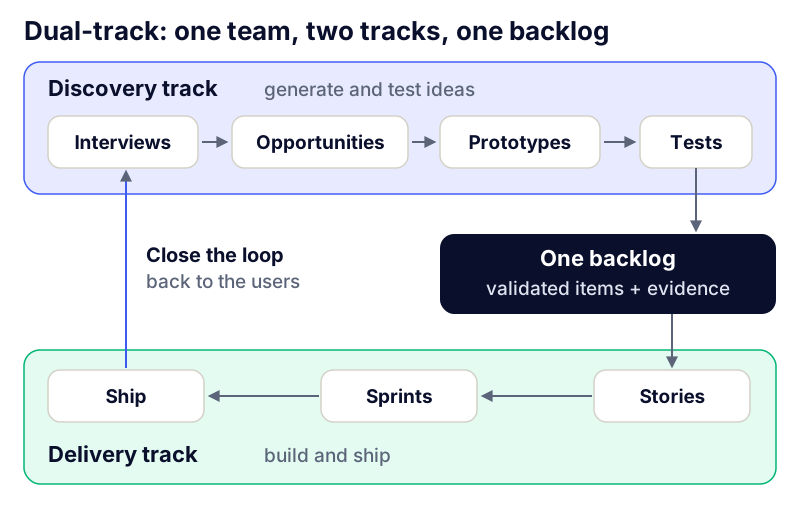
Two tracks, one team, one backlog. The classic failure mode is splitting them into separate teams: a "discovery squad" that throws specs over a wall to a "delivery squad". That recreates the old business-analyst handoff and loses the shared context that makes discovery insights actionable. Discovery items should live in the same backlog as delivery items, just at an earlier stage of maturity — which also makes discovery work visible during sprint planning instead of being invisible "PM stuff".
Core discovery techniques (and when to use them)
1. Customer interviews
The workhorse of discovery. Weekly interviews with real users surface pains, workarounds and desires you will never see in analytics. The craft is in asking about past behavior rather than hypothetical opinions — we cover the details, recruiting and question design in our guide to user interviews.
2. Opportunity solution tree
A visual map that connects a target outcome (top) to the opportunities heard in interviews (middle) to candidate solutions and experiments (bottom). Its superpower is forcing the question "which need does this feature serve?" — any solution that can't be attached to an opportunity is a solution looking for a problem.
3. Prototypes
From paper sketches to clickable Figma flows to Wizard-of-Oz setups where a human fakes the backend. Prototypes answer usability risk and sharpen value conversations: users react very differently to a concrete artifact than to a described idea. Rule of thumb: prototype at the lowest fidelity that can kill the idea.
4. Assumption tests and experiments
Fake door test: a button or landing page for a feature that doesn't exist yet; measure clicks and signups.
Concierge test: deliver the value manually to a handful of customers before automating anything.
A/B test: for optimization questions once you have traffic.
Data mining: usage analytics and support tickets to size a problem before interviewing about it.
Pick the technique by the riskiest assumption: if you're unsure anyone wants it, run a fake door; if you're unsure they can use it, run a usability test; if you're unsure you can build it, run a technical spike.
Who does what: the product trio
Discovery is not the PM's private hobby. The most effective setup is the product trio:
Product manager: owns value and viability risk. Frames the outcome, recruits participants, connects findings to the roadmap and to team OKRs.
Product designer: owns usability risk. Turns opportunities into testable prototypes, co-leads interviews, maps user flows.
Tech lead / engineer: owns feasibility risk. Spots cheap-to-build alternatives the others can't see, kills impossible ideas early, prototypes technical spikes.
When engineers attend interviews, two things happen: estimates get sharper (they've heard the actual need, not a summary of it), and creative solutions emerge earlier. A trio watching an interview together generates more usable insight than a PM circulating notes afterward.
From discovery to delivery without losing the signal
The most underrated failure point of discovery is the handoff. A team learns something real in interviews, then three weeks later the ticket in the backlog says "Add export button" with no trace of why. Here's how to keep the signal alive:
Attach evidence to backlog items. Every validated item should carry its supporting verbatims, interview links and experiment results — not in a separate research wiki nobody opens.
Write the problem, not just the solution. Frame items as "users can't X, which causes Y" so the delivery team can push back on scope intelligently. This pairs naturally with well-written user stories.
Keep acceptance criteria tied to the validated behavior, not to the prototype's pixels.
Close the loop after shipping. Go back to the users who surfaced the need. It validates the build and keeps interview pipelines warm.
Teams that structure their roadmap around outcomes rather than feature lists find this handoff far easier — see outcome-based roadmaps vs feature roadmaps for how to frame it.
Discovery mistakes to avoid
Discovery theater: interviews happen, sticky notes multiply, and the roadmap doesn't change. Test: name one idea you killed last quarter because of discovery. If you can't, it's theater.
Comfort validation: only asking questions that confirm the plan ("Would you use this?" — everyone says yes). Ask about past behavior and money spent instead.
Outsourcing discovery entirely: research agencies can help scale, but a trio that never talks to users loses its instincts.
Sampling only fans: interviewing your five friendliest customers systematically overstates value. Include churned users and non-customers.
Insights without a home: findings scattered across docs, Slack and heads. If insight retrieval takes more than a minute, it won't influence decisions.
Discovery as a gate: demanding "full validation" for every small improvement. Scale the rigor to the size of the bet.
Running discovery with RoadmapHero
Discovery produces two assets that need a durable home: evidence and decisions. In RoadmapHero, the Customer Voice module centralizes feedback and interview takeaways and links each piece to the features it supports — so when an idea reaches the backlog, its evidence travels with it. That user signal then feeds the HeroScore, RoadmapHero's customizable prioritization score, where customer weight sits alongside business value, effort and risk. The result: discovery findings don't just inform the roadmap rhetorically, they literally move items up or down. You can organize the whole feedback pipeline the same way. Free trial, transparent pricing in euros, no long-term commitment.
Frequently asked questions
How much time should a product team spend on discovery?
A common benchmark is that the product trio (PM, designer, tech lead) spends 20–40% of its time on discovery activities, with at least one customer touchpoint per week. Delivery teams keep shipping in parallel — discovery is continuous, not a phase that blocks the roadmap.
What is the difference between product discovery and user research?
User research is one input into discovery. Product discovery is the broader decision process: identifying opportunities, generating solutions, and testing the riskiest assumptions (value, usability, feasibility, viability) before committing engineering time.
Do small teams and startups need product discovery?
Yes — arguably more than anyone. A startup that ships the wrong feature burns a much larger share of its runway than an enterprise team. Lightweight discovery (5 interviews, a clickable prototype, a fake-door test) can be run in a week and costs far less than a wasted quarter.
What is an opportunity solution tree?
A visual map popularized by Teresa Torres. At the top sits a desired outcome (e.g. "increase activation by 15%"), below it the opportunities (user needs, pains, desires) discovered through interviews, and below each opportunity the candidate solutions and the experiments that test them. It keeps solutions tied to real needs instead of feature ideas floating free.
How do you avoid "discovery theater"?
Discovery theater is running interviews and workshops without letting the findings change any decision. The antidote: attach every discovery effort to a real decision with a deadline ("do we build X next cycle?"), write down what evidence would kill the idea before you start, and track how many roadmap items were changed or dropped because of discovery.