Roadmap vs Backlog: Differences and How They Connect
Roadmap vs backlog: horizon, granularity, audience and promise compared — plus the feedback loop that connects them and the mistakes that blur the line.
By the RoadmapHero team · Updated on · 6 min read

Key takeaways
- A product roadmap is a strategic communication artifact of themes, outcomes and epics by horizon, while the backlog is the ordered inventory of concrete work items.
- The four key differences are horizon (months vs days to weeks), granularity (10–20 lines vs hundreds of items), audience (whole company vs delivery team) and promise.
- The two connect through a loop: feedback enters the backlog, scoring ranks it, clusters of evidence graduate to the roadmap, and refinement feeds discoveries back up.
- Avoid publishing the backlog as a roadmap, since stakeholders read ranked tickets as promises; share a roadmap view with horizons and themes instead.
Roadmap vs backlog sounds like a vocabulary question, but it's really a governance question: what do you promise, to whom, at what granularity? Teams that blur the two either publish their backlog as a roadmap (and get held to 200 accidental promises) or run a roadmap disconnected from delivery (and get held to zero). This guide defines both artifacts, isolates the four differences that matter, and shows the feedback loop that keeps them synchronized.
What is a roadmap?
A product roadmap is a strategic communication artifact. It tells the organization — and sometimes customers — which problems you will tackle over the coming months, in what order, and why. Its content is themes, outcomes and epics organized by horizon; its job is alignment and expectation-setting.
A good roadmap fits on one screen, changes on a known cadence, and every line on it can be traced to a strategic goal. For construction details, see how to create a product roadmap.
What is a backlog?
The product backlog is the ordered inventory of concrete work: user stories, bugs, technical tasks, improvements. It is the team's raw material — written in delivery language, estimated, refined, and consumed sprint by sprint. Where the roadmap is curated for readability, the backlog is exhaustive by design: it can hold hundreds of items, as long as they're ranked and the top is kept sharp. Practices for keeping it navigable are covered in how to better manage your backlog.
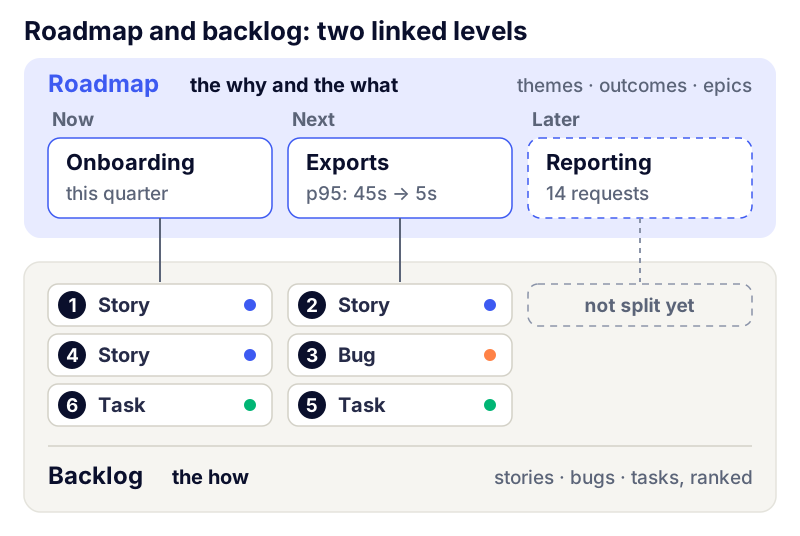
Ownership also differs: the PM curates and ranks the backlog, but the whole team contributes to it — engineers file debt items, support relays bugs, designers add usability findings. Nobody outside the team needs to read it, and that's a feature: it can stay technical, half-formed and brutally honest in a way a roadmap never can.
The 4 key differences
Dimension | Roadmap | Backlog |
|---|---|---|
Horizon | Months to a year | Days to weeks (top), unlimited (tail) |
Granularity | Themes, outcomes, epics (10–20 lines) | Stories, bugs, tasks (dozens to hundreds) |
Audience | Executives, sales, customers, whole company | The delivery team |
Nature of promise | Direction and intent, selectively committed | No promise — an ordered possibility space |
The audience difference drives everything else. Stakeholders reading a roadmap need narrative ("we're investing in onboarding this quarter, here's why"); engineers reading a backlog need precision (acceptance criteria, estimates, dependencies). Serving both audiences with one artifact fails both.
How they feed each other
The two artifacts stay healthy only when connected by an explicit loop:
Feedback enters the backlog. Support tickets, sales notes, user interviews and feature requests are captured, deduplicated and linked to the users who asked. A structured intake — see customer feedback management — prevents this stage from becoming a suggestion-box void.
Prioritization ranks the backlog. Scoring (RICE, WSJF, or a weighted composite) turns the raw inventory into a defensible ranking. The frameworks are compared in how to prioritize your backlog.
Clusters graduate to the roadmap. When ranked items cluster around a problem ("14 high-value requests about reporting"), the cluster — not the individual tickets — becomes a roadmap theme or epic with an intended outcome.
The roadmap frames refinement. Upcoming roadmap items are broken down into stories during backlog refinement, estimated, and pulled into sprints. Discoveries made here (hidden complexity, better ideas) flow back up and can resize or resequence the roadmap.
Delivery updates both. Shipped work closes backlog items, advances roadmap status, and generates new feedback — which restarts the loop.
The loop in practice: an example
A B2B SaaS receives 23 pieces of feedback over two months mentioning slow report exports. Individually, each is a minor backlog item. Aggregated and scored, the cluster ranks 2nd in the backlog by weighted value. The PM promotes a roadmap epic — "Exports that scale: cut p95 export time from 45s to 5s" — into the "Next" lane of a Now-Next-Later roadmap. During refinement, the team discovers the fix requires an async job queue: the epic grows, a dependency is recorded, and one smaller epic slips a slot. Stakeholders see one honest change in the monthly roadmap update — not 23 tickets moving.
Notice what each artifact did: the backlog absorbed noise and preserved detail; the roadmap communicated one strategic commitment and one change. Neither could have done the other's job.
Mistakes that blur the line
Publishing the backlog as a roadmap: stakeholders read ranked tickets as sequenced promises, then hold you to an ordering that changes weekly.
A roadmap with no delivery link: strategy slides that no backlog item references. Six months later the roadmap says "done-ish" and delivery says otherwise.
Roadmap items written like tickets: "Fix pagination bug on invoices page" is not a roadmap line; it starves stakeholders of the why.
Backlog items written like themes: "Improve onboarding" as a story is unrefinable; it stalls sprints.
Two unsynchronized tools: the roadmap in slides, the backlog in a tracker, reconciled manually once a quarter — which means never.
Skipping the aggregation step: promoting single loud requests straight to the roadmap instead of clusters of evidence.
Health checks for both artifacts
Traceability: 80%+ of sprint points trace to a roadmap item; every roadmap item has at least one linked backlog item once it enters "Next".
Size: roadmap readable in 5 minutes; backlog top-30 refined and estimated.
Freshness: roadmap updated at least monthly; backlog top reprioritized weekly.
Evidence: roadmap themes cite feedback volume or metric targets, not just opinions.
Run these checks quarterly. The most common failure found is one-way traceability: backlog items point to roadmap epics, but roadmap items in "Later" have no backlog existence at all — meaning nobody has tested whether they're even feasible. One refinement pass on upcoming "Later" items per quarter fixes this cheaply, and regularly kills items before they become public commitments.
A typical workflow in RoadmapHero
RoadmapHero implements this loop natively rather than across three tools. Customer Voice centralizes feedback and links each piece to backlog items, so evidence accumulates against features automatically. The backlog is scored with HeroScore — business value tied to OKRs, user value weighted by Customer Voice, effort, risk — producing the ranking that feeds roadmap decisions. Epics group stories, so a roadmap line always knows its delivery state, and dependencies and ticket health surface refinement discoveries early. When priorities shift, the roadmap view updates from the same data — no slide-deck reconciliation — and shared views give stakeholders a live, readable roadmap with unlimited viewers. Free trial, transparent euro pricing, no commitment.
Frequently asked questions
Is the roadmap just the top of the backlog?
No. The roadmap is a strategic communication tool organized around themes and outcomes over months; the backlog is an execution inventory of concrete work items. Roadmap items are typically backed by many backlog items, but the two answer different questions for different audiences.
Which comes first, the roadmap or the backlog?
They co-evolve. Strategy shapes the roadmap, the roadmap frames what gets refined into backlog items, and backlog signals (feedback, bugs, effort discovered during refinement) flow back up and reshape the roadmap. It is a loop, not a sequence.
Can I show my backlog to stakeholders instead of a roadmap?
Avoid it. A backlog exposes granularity and ordering that stakeholders misread as promises, and it hides the strategy. Share a roadmap view with horizons and themes; keep the backlog as the team's working inventory.
How many items should a healthy backlog contain?
Enough for 2–3 months of refined work at the top, plus a managed pool behind it. Beyond a few hundred items, honesty helps: archive what you will realistically never do. A 2,000-item backlog is a graveyard, not a plan.
Do I need separate tools for roadmap and backlog?
Not necessarily, and keeping them linked in one system avoids the classic drift where the roadmap says one thing and delivery does another. What matters is that each roadmap item traces to backlog items and vice versa.