Now-Next-Later Roadmap: The Complete Guide (2026)
The complete guide to the Now-Next-Later roadmap: origin, why it beats date-based roadmaps, how to define each horizon, examples and classic mistakes.
By the RoadmapHero team · Updated on · 6 min read
Key takeaways
- A Now-Next-Later roadmap arranges work by confidence instead of dates: Now is committed work in progress, Next holds validated priorities and Later gathers directional bets.
- Keep 3 to 6 items in Now, 5 to 8 in Next and up to 10 themes in Later, with detail and confidence decreasing from left to right by design.
- Move items on explicit criteria: Later to Next when linked to an OKR and confirmed by discovery, Next to Now when scope is cut, capacity is free and a success metric is agreed.
- Review Now weekly, Next monthly and the whole roadmap quarterly, and flag real external deadlines on the items concerned instead of hiding them.
The Now-Next-Later roadmap is the most widely adopted answer to a problem every product team knows: date-based roadmaps turn estimates into promises, and broken promises into lost credibility. Instead of arranging work on a calendar, Now-Next-Later arranges it by proximity and confidence — what we are doing now, what comes next, and what we believe in for later. Simple to read, hard to master. This guide covers both.
What is a Now-Next-Later roadmap?
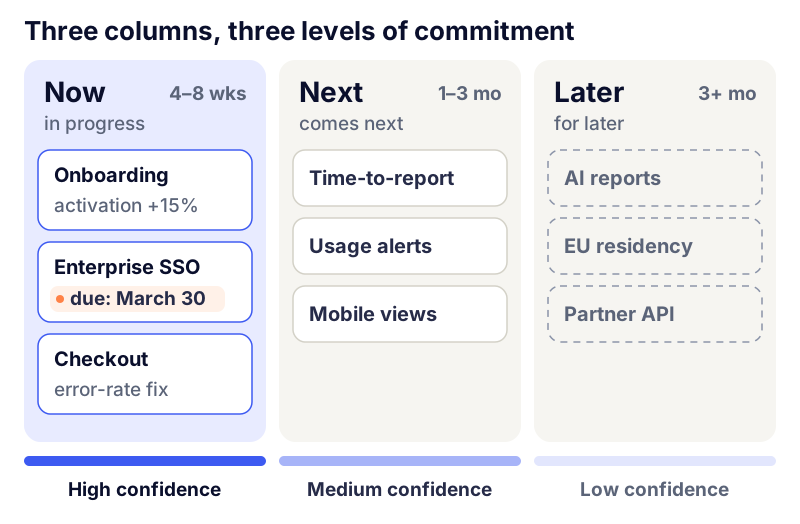
Three columns, three levels of commitment:
Now — work actively in progress or starting imminently. High confidence, precise scope, named owners.
Next — validated priorities queued after Now. Medium confidence: the problem is chosen, the solution still flexible.
Later — directional bets and themes. Low confidence on scope and timing, high clarity on intent.
The genius of the format is that uncertainty is displayed instead of hidden. A Gantt bar eighteen months out claims a precision nobody has; a "Later" card claims exactly what the team knows — the direction.
Where it comes from
The format was popularized in the early 2010s by Janna Bastow, co-founder of ProdPad and Mind the Product, who famously described the timeline roadmap as a Gantt chart in disguise. Her argument: product development is discovery under uncertainty, and a roadmap should be a prototype of your strategy, not a delivery contract. The idea spread through the lean and continuous-discovery movements and is now the default format at thousands of product companies — precisely because it survives contact with reality: when priorities shift, you move a card instead of rebuilding a timeline.
Why it beats date-based roadmaps for product work
Aspect | Date-based roadmap | Now-Next-Later |
|---|---|---|
What it communicates | Delivery promises | Priorities and confidence |
Cost of change | High — every shift cascades | Low — move a card |
Stakeholder conversation | "Why is it late?" | "Why is this a priority?" |
Team behavior | Padding, date-driven scope cuts | Focus on outcomes |
Best suited for | Fixed-date projects, launches | Continuous product development |
Note the last row: this is not date-bashing. Marketing launches, compliance deadlines and contractual milestones have real dates, and a good Now-Next-Later roadmap flags them on the relevant items. What it removes is the invented date — the one that existed only because the template had a column for it. The format also pairs naturally with outcome-oriented planning, a topic we expand in outcome-based vs feature roadmaps.
Defining each horizon properly
Now — precise and small
Timebox: roughly the current 4–8 weeks, though the column is defined by commitment, not by calendar. Each item has a clear problem statement, a scoped solution, an owner and a success metric. Rule of thumb: 3–6 items maximum. If Now is crowded, it is not a roadmap — it is a backlog, and the difference matters (see roadmap vs backlog).
Next — problems chosen, solutions open
Horizon: typically the following 1–3 months. Items are validated priorities expressed at problem level ("reduce time-to-first-value for new workspaces") with discovery possibly still running. 5–8 items. This is where prioritization debates should concentrate.
Later — themes and bets
Horizon: 3+ months, deliberately fuzzy. Items are themes ("expand to multi-product analytics") tied to strategy, not scoped features. Later exists to show direction and to give stakeholders a legitimate place to park ideas without committing the team.
Criteria for moving items between horizons
The roadmap only lives if items flow. Make promotion criteria explicit:
Later → Next when: the theme maps to a current OKR, early discovery confirms the problem is real and sizable, and a prioritization score justifies it against alternatives.
Next → Now when: discovery is done, scope is cut to a shippable slice, capacity is actually free (not "will be soon"), and a success metric is agreed.
Any column → out when: the linked objective changed, the score dropped below alternatives, or the assumption behind it died. Removal is a healthy output of the process, not a failure.
Anchor these moves to your goals — aligning horizons with objectives is the core discipline, detailed in how to align your roadmap with OKRs.
A concrete example: B2B SaaS, 20-person team
Now: Self-serve onboarding revamp (activation +15% target) · SSO for enterprise deals (contractual date flagged: March 30) · Checkout error-rate fix.
Next: Reduce time-to-first-report (top Customer Voice theme, 42 linked requests) · Usage-based alerts (discovery running) · Mobile read-only views.
Later: AI-assisted report building · EU data residency · Partner API program.
Notice what the format makes visible: one real external date (flagged, not hidden), feedback evidence on a Next item, and Later entries that are strategic direction, not padded feature lists.
Classic mistakes (and how to avoid them)
Now-Next-Later as disguised quarters. If Now = Q1, Next = Q2, Later = Q3, you rebuilt a timeline with vaguer labels. Horizons are confidence levels, not calendar slots.
A frozen Later. If nothing has moved out of Later in six months, it is a graveyard. Review it quarterly and delete without guilt.
Same granularity everywhere. Fully-specced features in Later signal wasted design effort and false certainty. Detail should decrease to the right.
No "why" on cards. Every item needs its objective and its evidence (score, feedback count). Without it the roadmap is a wishlist.
Skipping the review ritual. The format assumes movement; without a weekly Now check and monthly Next review, it stales like any artifact.
Hiding real deadlines. Pretending a regulatory date does not exist discredits the format. Flag true dates on the items concerned.
Selling Now-Next-Later to stakeholders
Executives used to Gantt charts may initially read Now-Next-Later as evasion. Three arguments that land: first, the old roadmap's dates were already fiction — this format just stops laundering estimates as commitments. Second, real commitments (contracts, compliance) remain dated and flagged. Third, they gain a better question: instead of auditing schedule slippage, they get to challenge priorities, which is where their input is actually valuable. A shared, always-current view helps enormously here — see our guide to public product roadmaps for making the roadmap a communication asset.
Setting up Now-Next-Later in RoadmapHero
RoadmapHero treats Now-Next-Later as a first-class roadmap view: columns map to horizons, and each card carries its linked OKR, its HeroScore and its Customer Voice feedback count — so the "why" travels with every item. Moving an item between horizons is a drag-and-drop; the shared view updates instantly for every stakeholder, with unlimited viewers and scheduled recurring sharing. Real deadlines are flagged on the tickets concerned, and the White Rabbit agent replans quietly when delivery slips. Import your current roadmap (CSV, Notion, Trello, Jira) and you can run your first horizon review the same day, on a free trial.
Frequently asked questions
What does Now, Next and Later mean on a roadmap?
Now contains work in progress or starting imminently, defined precisely. Next holds validated priorities coming after, defined at problem level. Later gathers directional bets, defined as themes. Confidence and detail decrease as you move right — by design.
Who invented the Now-Next-Later roadmap?
The format was popularized by Janna Bastow, co-founder of ProdPad and Mind the Product, in the early 2010s, as a lean alternative to Gantt-style timelines that kept turning estimates into commitments.
Does Now-Next-Later mean no deadlines at all?
No. Real external deadlines (regulatory dates, contractual commitments, seasonal events) still exist and should be flagged on the items concerned. What disappears is the artificial deadline invented for every item just because the format demanded a date.
How many items should each horizon contain?
A useful rule of thumb: 3-6 items in Now, 5-8 in Next, and up to 10 themes in Later. If Now holds fifteen items, it is a task list, not a statement of focus.
How often should a Now-Next-Later roadmap be reviewed?
Review Now weekly as part of delivery rituals, Next monthly, and the whole roadmap quarterly alongside your OKR review. The format only works if items genuinely flow between horizons.