How to Align Your Roadmap With OKRs
Stop roadmap-OKR drift: link every initiative to a key result, weight prioritization by OKRs and run quarterly cross-reviews. Full worked example inside.
By the RoadmapHero team · Updated on · 7 min read
Key takeaways
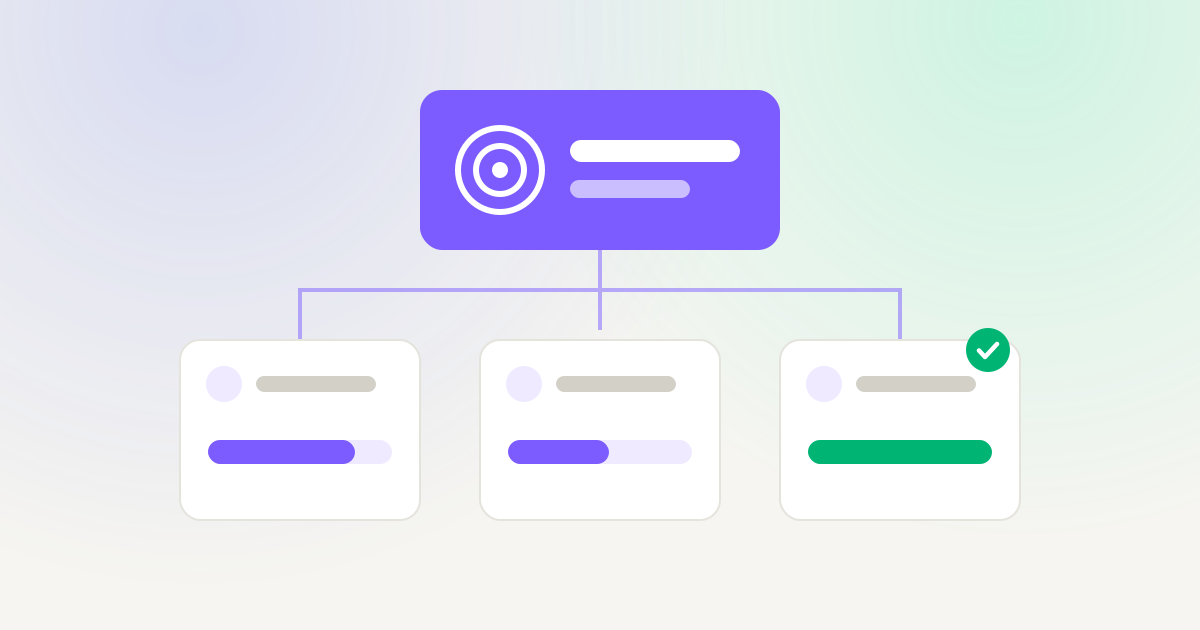
- Roadmaps and OKRs drift apart structurally, because the roadmap faces daily pressure while OKRs get quarterly attention; the fix is a link, a weight and a ritual.
- Every roadmap initiative should name the Key Result it serves or carry an explicit exception tag, with 60–80% of work OKR-linked rather than 100%.
- Make contribution to current OKRs the dominant term of your prioritization score, so an initiative serving no Key Result must be exceptional on every other axis.
- Run a 45-minute cross-review mid-quarter and a double retrospective at quarter end to reallocate capacity away from bets that shipped but did not move their KR.
Most product teams maintain two documents that are supposed to describe the same future: the OKRs (outcomes to achieve) and the roadmap (things to build). Learning to align your roadmap with OKRs means making one document answerable to the other — so that shipping the roadmap actually moves the numbers you committed to. This article gives you the full method: linking, weighted prioritization, cross-reviews, a worked example, and the anti-patterns that quietly undo the whole thing.
Why roadmaps and OKRs drift apart
The drift is structural, not a discipline failure. The two artifacts have different natures and different audiences:
The roadmap speaks output: features, epics, dates. It's negotiated with sales, customers and engineering, and it accretes commitments — "we promised this at the last QBR".
The OKRs speak outcome: metric movements. They're negotiated with leadership once a quarter, then often left alone.
Because the roadmap gets daily pressure and the OKRs get quarterly attention, the roadmap wins every micro-conflict. Three months later the team has shipped eleven things, the KRs have barely moved, and the retrospective concludes — again — that "we need more focus". The fix is not motivation; it's mechanical coupling, in three layers: a link, a weight, and a ritual. (If your roadmap is a pure feature list, fixing that first helps — see outcome-based vs feature roadmaps.)
The linking method: every initiative → a KR
The core rule fits in one sentence:
Every roadmap initiative names the Key Result it serves — or carries an explicit exception tag.
In practice, four steps at quarter start:
Write OKRs first. Outcomes before bets. If you need help there, start with our OKR guide for product teams.
Map existing initiatives. For each item on the roadmap, ask "which KR does this move, and by roughly how much?". Three honest answers exist: a specific KR, an exception category, or no answer.
Handle the "no answer" pile explicitly. These items aren't automatically bad — but they must either be re-argued as an exception (compliance, contractual, strategic bet) or leave the quarter. This step usually frees 20–30% of capacity.
Budget the exceptions. Set an explicit split, e.g. 70% OKR-linked / 20% run-the-business / 10% debt. The split is a leadership decision made once, which then absorbs dozens of future debates.
The test of a healthy linkage: anyone can pick a roadmap item and recite the chain "this initiative → this KR → this Objective" in under ten seconds.
OKR-weighted prioritization
Linking says whether an initiative serves the goals; weighting says how much that matters in ranking. The idea: make "contribution to current OKRs" the dominant term in your prioritization score. A simple recipe on a 1–5 scale:
OKR contribution (weight ×3): how strongly this initiative is expected to move its linked KR.
User value (×2): customer feedback pressure, reach.
Effort (÷): sizing in weeks or story points.
Risk and urgency (×1): windows, dependencies, decay.
This is exactly how RoadmapHero's HeroScore is designed: the business-value criterion reads the initiative's linked OKR contribution, you set the weights, and the backlog reorders accordingly. The point isn't the formula's precision — it's that an initiative serving no KR must now be exceptional on every other axis to reach the top, which is precisely the behavior you want. For the broader tooling landscape, see our review of prioritization tools.
Quarterly cross-reviews
The link and the weight decay without a ritual. Two reviews keep them honest:
Mid-quarter cross-review (45 min). Read the OKRs first, then the roadmap. For each at-risk KR: is the linked work late, or shipped-but-flat? Late → unblock or reallocate. Flat → the bet was wrong; stop polishing it and move capacity to the next-best initiative on that KR. End with at most three explicit roadmap changes.
End-of-quarter double retrospective (60 min). Score the KRs, then audit the mapping itself: which initiatives moved their KR as predicted? Which "sure things" did nothing? Track your hit rate (share of shipped initiatives that moved their KR) quarter over quarter — improving that number is improving your product judgment.
Note what's absent: no weekly roadmap-vs-OKR meeting. The weekly OKR check-in already exists; the cross-review is deliberately infrequent and decisive.
A complete worked example
A B2B SaaS team (8 engineers) enters Q3 with one Objective: "New customers succeed without our help", carrying two Key Results:
KR1: onboarding completion without human assistance, 41% → 65%.
KR2: median time-to-first-value, 6 days → 2 days.
The roadmap mapping session produces:
Initiative | Linked KR | Expected contribution | Decision |
|---|---|---|---|
Interactive setup checklist | KR1 | High (+10 pts est.) | Priority 1 |
Sample-data workspace on signup | KR2 | High (−2 days est.) | Priority 2 |
CSV import wizard v2 | KR2 | Medium | Priority 3 |
Admin audit log | — (exception: contractual) | — | Kept, 15% capacity cap |
Dark mode | — (no KR, no exception) | — | Moved out of the quarter |
At the mid-quarter cross-review, KR1 sits at 48% (on track), but KR2 is stuck at 6 days despite the sample workspace shipping in week 4 — the bet was wrong: users skip the sample data entirely. The team stops iterating on it, promotes the import wizard, and adds a "connect your Jira in 2 clicks" initiative instead. Quarter ends: KR1 at 63% (score 0.9), KR2 at 3 days (score 0.75). The drift that would have consumed the quarter was caught in week 6 — that's the alignment paying rent.
Anti-patterns to watch for
Decorative OKRs. Every initiative gets retro-labeled with a KR after the roadmap is set. Linking happened; alignment didn't. Tell: the mapping session never removes or reorders anything.
Double bookkeeping. OKRs in a slide deck, roadmap in a tool, mapping in a third spreadsheet that only the PM updates. Three sources of truth equal zero. Keep goals and roadmap in the same system.
100% linkage theater. Forcing every bug fix and library upgrade under a KR produces absurd mappings and discredits the method. Use exception budgets.
The immovable roadmap. A mid-quarter KR alarm that never changes the plan means the OKRs are a dashboard, not a steering wheel.
Output KRs laundering the problem. If the KR itself is "ship the checklist", linking is circular. Fix the KRs first — see how to write good OKRs.
Doing all this in RoadmapHero
RoadmapHero implements the three layers natively. The Vision & OKR module holds Objectives and Key Results next to the roadmap, and every initiative links to the KR it serves — the chain is visible on the ticket itself. The HeroScore weights prioritization by OKR contribution alongside user value (fed by Customer Voice), effort and risk, so the ranking follows the goals automatically. And the AI progression analysis prepares your cross-reviews for you: an actionable summary per Key Result — what shipped, what moved, where the bet looks wrong — so the mid-quarter meeting starts at the decision, not at the data. Free trial, transparent euro pricing, no commitment, unlimited viewers on shared views.
Frequently asked questions
Should 100% of roadmap initiatives be linked to an OKR?
No — aim for 60–80%. Keep explicit capacity for keep-the-lights-on work, tech debt and small customer commitments. What matters is that unlinked work is a deliberate, sized bucket rather than an invisible leak.
What comes first, the roadmap or the OKRs?
OKRs, slightly. Draft the quarter's OKRs from your strategy first, then shape the roadmap as your best bets to move them. In practice the two iterate together for a week or two — that negotiation is healthy as long as OKRs stay the yardstick.
What if an initiative serves two Key Results?
Link it to both, but designate a primary KR for scoring and reporting. If most initiatives claim multiple KRs, your Key Results probably overlap and should be sharpened.
Mid-quarter, a KR is clearly off track. Should we change the roadmap?
That is exactly what the alignment is for. First check the diagnosis: is the initiative late, or shipped but not working? If shipped and flat, stop scaling it and reallocate to the next-best bet on that KR. Changing the roadmap to serve the OKR is discipline, not churn.
Do we need a dedicated tool to align roadmap and OKRs?
You can start in a spreadsheet, but the link decays fast because it must be maintained by hand at every reprioritization. A tool where initiatives natively carry a Key Result link — like RoadmapHero with OKR-weighted HeroScore — keeps the alignment alive without ongoing bookkeeping.