Why use OKRs? 7 concrete benefits for your team
Alignment, focus, prioritization, transparency, measurement: 7 concrete benefits of OKRs for product, project and leadership teams.
By the RoadmapHero team · Updated on · 3 min read
Key takeaways
- An OKR pairs a qualitative Objective with 2 to 5 measurable Key Results, and the method only delivers value when a team knows why it is adopting it.
- OKRs align the organization on one direction, force focus by capping each team at 2–3 Objectives per cycle, and act as a compass for backlog prioritization.
- Key Results shift teams from outputs, such as features shipped, to outcomes, and OKR culture treats a score of 0.7 out of 1 as a good result.
- Skip OKRs when your strategy changes every month, your team is firefighting 90% of the time, or leadership wants individual OKRs tied to bonuses.
Many teams adopt OKRs "because everyone else does" and lose interest six months later. The method is not magic: it only delivers when you know why you put it in place. This article goes through the 7 benefits you can realistically expect from OKRs, and the conditions to get them.
Quick recap: what is an OKR?
An OKR (Objectives and Key Results) pairs a qualitative Objective with 2 to 5 measurable Key Results that prove the Objective is reached. New to OKRs? Start with what is an OKR?.
1. Align the entire org on the same direction
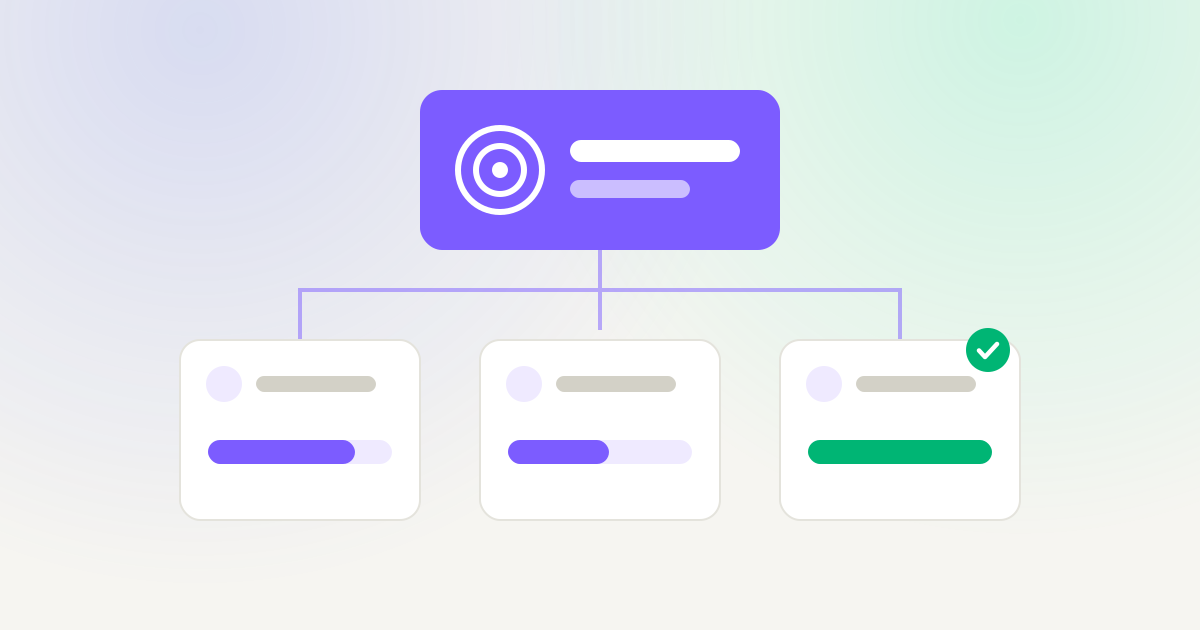
The first benefit is vertical alignment: each team can tie its Objectives to higher-level company goals. No more guessing whether a project actually serves the strategy: it's visible on the chart. Horizontally, alignment between teams (product, sales, support…) becomes easier because everyone reads the same map.
2. Force focus
Capping each team to 2-3 Objectives per cycle is politically difficult but incredibly effective. It forces trade-offs upfront: anything that's not in the OKRs is not a priority this quarter. Teams that succeed with OKRs are almost always the ones that dare to say no.
3. Power up prioritization
Once OKRs are set, they become the compass for the backlog. Every request becomes: "does this idea contribute to an Objective, and how much?". Scoring frameworks (RICE, HeroScore) get more useful because they can factor OKR contribution into the value calculation. See prioritization frameworks.
4. Make strategy transparent
When properly shared, OKRs make trade-offs visible: why this initiative ranks higher than that one, why this team is prioritized this quarter. The dynamic in steering committees changes: you talk about goals and progress, not about who shouts loudest.
5. Measure what matters
Key Results force a shift from "we shipped 12 features" to "we lifted activation from 22% to 35%". That's the difference between an output (what we produce) and an outcome (the effect we observe). Over time, this shift is what separates a learning team from a feature factory.
6. Cultivate reasonable ambition
OKR culture treats a 0.7/1 score as a good score. This invites teams to aim higher without spiraling into guilt when an Objective isn't 100% met. It's a great hedge against sandbagging (deliberately low targets to ensure you hit them).
7. Grant autonomy without losing control
Once OKRs are defined and shared, leadership can focus on results rather than methods. Teams gain autonomy: you agree on the what and the why, you let them own the how. It's a powerful engagement lever.
When OKRs are not the right answer
OKRs are not universal. Skip them, or use them lightly, when:
Your strategy changes every month (OKRs need a stable horizon).
Your team is in firefighting mode 90% of the time (stabilize first).
Leadership wants individual OKRs tied to bonuses (you'll kill the spirit).
You're not ready to say no to non-OKR work (don't bother starting).
For practical next steps, see what is an OKR? and the 5 best OKR tools in 2026.
Frequently asked questions
Do OKRs replace KPIs?
No. KPIs track ongoing health. OKRs set an ambitious direction for a cycle. Both coexist: a KPI can become a Key Result when you decide to move it.
How long until a team adopts OKRs?
Plan 1 to 2 cycles (3 to 6 months) for the mechanics to feel natural. The first OKRs are rarely perfect — that's normal; the point is to learn through reviews.
Do OKRs work for non-tech teams?
Yes. The method was born at Intel and works very well for HR, finance, ops or marketing teams. The key is to write Key Results that measure outcomes, not activity.
Do you need a dedicated tool to use OKRs?
Not to start: a spreadsheet can be enough. As soon as you manage several teams or want to connect OKRs, roadmap and execution, a dedicated tool — like RoadmapHero — pays for itself.