The 5 Best OKR Tools in 2026
A 2026 comparison of the best OKR tools: RoadmapHero, Workboard, Perdoo, Gtmhub and Notion. Features, pricing, integrations and use cases.
By the RoadmapHero team · Updated on · 4 min read
Key takeaways
- In 2026, the best OKR tools connect objectives to strategy, the backlog, team rituals and execution, and that integration often decides long-term adoption.
- To connect OKRs, roadmap and backlog, RoadmapHero is the most complete option, while Workboard or Gtmhub suit large enterprises focused on pure OKRs.
- Perdoo suits teams learning the OKR method, and Notion lets you test OKRs before investing, despite having no native scoring or cycles.
- A spreadsheet works early on, but a dedicated OKR tool pays off beyond 3 teams or with multi-level OKRs, at around $9 to $25 per user per month.
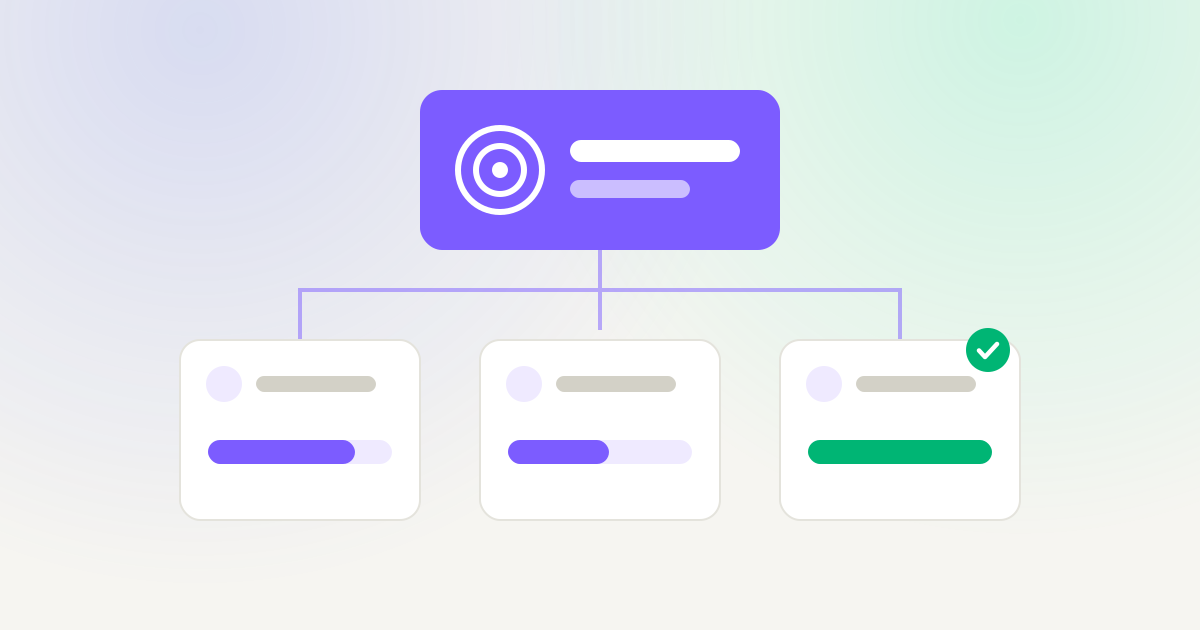
In 2026, the best OKR tools no longer just display objectives: they connect them to strategy, the backlog, team rituals and execution. That integration is what often decides long-term adoption.
How we compared
We evaluated 10 tools against 7 criteria:
Multi-level OKR modeling (company, BU, team, individual)
Cycles, check-ins and automatic scoring
Link to initiatives, roadmap and backlog
Dashboards and alignment visualization
Integrations (Slack, Jira, GitHub, Notion, BI)
Onboarding and adoption (UX, embedded coaching)
Value for money
Here are the 5 finalists.
1. RoadmapHero — Most complete to connect OKRs and execution

RoadmapHero is built as a Product OS: OKRs, roadmap, backlog and execution in a single tool. OKRs don't live in a silo — every ticket, every initiative, every shared view can be explicitly tied to an Objective and a Key Result.
Strengths
Multi-level OKRs (company, BU, team) with automatic link to the backlog.
HeroScore: prioritization weighs real contribution to OKRs.
Per-OKR shareable views for leadership, teams and customers.
Native integrations: Jira, GitHub, Slack, Notion.
Built-in AI to suggest Key Results and summarize progress.
Who is it for?
Product teams, PMOs, founders and leaders who want one tool from strategy to execution.
Try RoadmapHero for free · 7 days, no credit card.
2. Workboard
Workboard is a mature tool focused on OKRs + execution management, widely adopted in enterprises. Its strength: embedded OKR coaching and structured rituals.
Strengths
Embedded OKR coaching and adoption programs.
Solid cycles, check-ins and scoring.
Strong multi-level coverage (BUs, divisions, teams).
Limits
High enterprise pricing.
Less native link to the product backlog.
Non-trivial learning curve.
3. Perdoo
Perdoo positions itself as a simple, pedagogical OKR tool, with clean UX and rich learning content.
Strengths
Excellent ease of use, even for OKR newcomers.
Clear OKR hierarchy (Strategy → OKRs → Initiatives).
High-quality learning resources.
Limits
Less powerful for very large organizations.
More limited integrations than the leaders.
Not designed to drive backlog or roadmap.
4. Gtmhub (Quantive)
Gtmhub (now Quantive) targets large data-driven organizations with native BI integrations and a powerful scoring engine.
Strengths
Rich BI integrations (Snowflake, Power BI, Looker…).
Automate Key Results from data sources.
Models OKRs at very large scale.
Limits
Complex initial setup, often requires a dedicated data team.
Better fit for large enterprises than SMBs.
Enterprise-oriented pricing.
5. Notion

Notion has no native OKR module but remains an excellent way to start, thanks to flexible databases and a community packed with templates.
Strengths
Very flexible, perfect to prototype an OKR system.
Excellent value for money.
Active community and templates.
Limits
No native scoring or cycles.
No automatic multi-level alignment.
Hard to maintain at scale over time.
Comparison table
| RoadmapHero | Workboard | Perdoo | Gtmhub | Notion |
|---|---|---|---|---|---|
Multi-level OKRs | ✅ | ✅ | ✅ | ✅ | Partial |
Cycles & auto scoring | ✅ | ✅ | ✅ | ✅ | ❌ |
Native link to initiatives & backlog | ✅ Native and bidirectional | ❌ | ❌ | ❌ | Manual |
Direct link to execution (tickets, sprints) | ✅ | ❌ | ❌ | Partial | ❌ |
OKR sharing to stakeholders (per-audience views) | ✅ | Partial | Partial | Partial | Manual |
Automated communication (release notes, changelog, FAQ) | ✅ | ❌ | ❌ | ❌ | ❌ |
Jira / GitHub integrations | ✅ | ✅ | Partial | ✅ | Partial |
BI / data | Partial | ✅ | Partial | ✅✅ | ❌ |
AI agent access (Claude Code / MCP) | ✅ | ❌ | ❌ | ❌ | ❌ |
Built-in AI | ✅ | Partial | Partial | ✅ | Partial |
Simple pricing, no license juggling | ✅ | ❌ | Partial | ❌ | ✅ |
How to choose?
Want OKRs, roadmap and backlog connected: RoadmapHero.
Large enterprise, pure-OKR focus: Workboard or Gtmhub.
Starting up, learning the method: Perdoo.
Testing OKRs before investing: Notion, then migrate.
To understand the method before picking a tool, read what is an OKR and why use OKRs.
Frequently asked questions
Which is the best OKR tool in 2026?
It depends on context. To connect OKRs, roadmap, backlog and execution in one tool, RoadmapHero is the most complete. For pure-OKR orgs that want embedded coaching, Workboard and Gtmhub are strong. To start small, Notion can do.
Do you need an OKR tool, or is a spreadsheet enough?
Early on, a spreadsheet works just fine. As soon as you have more than 3 teams, multi-level OKRs or want to connect OKRs and roadmap, a dedicated tool starts paying off.
Can you run OKRs in Jira or ClickUp?
You can, with limits. These tools are built for task management, not for OKR mechanics (cycles, scores, multi-level alignment). They remain useful for execution if you pair them with an OKR tool.
How do I integrate an OKR tool into my stack?
Look for native integrations (Slack, Jira, GitHub, Notion). RoadmapHero, for instance, syncs OKRs, backlog and tickets, so you don't track progress in two places.
What budget should I plan?
Plan around $9 to $25 per user per month for a standalone OKR tool. When OKRs are bundled in a Product OS like RoadmapHero, you pay for the full suite (roadmap + backlog + OKRs), often cheaper overall.