What is an OKR? Definition, examples and best practices
A clear definition of OKRs (Objectives and Key Results), concrete examples, a method to write them well and common mistakes to avoid.
By the RoadmapHero team · Updated on · 4 min read

Key takeaways
- An OKR (Objectives and Key Results) pairs a qualitative, inspiring Objective with 2 to 4 measurable Key Results that prove the Objective has been reached.
- Each Key Result has a baseline, a target and a date, and describes an outcome ("reach Y") rather than an activity ("ship X").
- A KPI tracks the ongoing health of an activity, while an OKR sets an ambitious direction for a cycle, typically a quarter.
- Aim for 2 to 3 Objectives per team per cycle, avoid tying OKRs to bonuses, and treat a 0.7/1 score as healthy rather than a miss.
OKRs are everywhere — from startups to large enterprises, from product teams to HR. Yet behind the acronym, many people still hesitate on what an OKR actually is, and how it differs from a KPI, an annual goal or a performance metric.
This article is deliberately pedagogical: we start with the definition, look at concrete examples, and finish with a practical how-to so you can write your first OKRs without falling into the classic traps.
Plain-English definition
An OKR (Objectives and Key Results) is a format to phrase a goal and measure whether you reach it. It pairs:
An Objective (O): a short, qualitative, inspiring sentence that describes what you want to achieve. Why it matters.
Key Results (KRs): 2 to 4 measurable outcomes that prove the Objective has been reached. How you'll know you made it.
In other words, an OKR turns a fuzzy intention into a clear direction + concrete metrics to track progress.
Rule of thumb: an Objective without Key Results is a slogan; Key Results without an Objective are a dashboard.
Where do OKRs come from?
The method was formalized by Andy Grove at Intel in the 1980s and popularized by John Doerr, who introduced it to Google in 1999. It then spread across most tech companies (LinkedIn, Spotify, Airbnb…) and into large organizations looking to create focus at scale.
Structure: an Objective + Key Results
The Objective: qualitative, ambitious, memorable
A good Objective can be read out loud in a meeting without needing explanation. It is:
Qualitative: it describes a desired state, not a number.
Ambitious yet realistic: it stretches the team without breaking it.
Aligned: it serves a higher-level OKR (company, BU…).
Key Results: measurable, no ambiguity
Each Key Result has a baseline, a target and a date. They answer the question: "how will we know in 3 months that the Objective was met?". Avoid KRs that describe activity ("ship X") in favor of those that describe an outcome ("reach Y").
Concrete examples
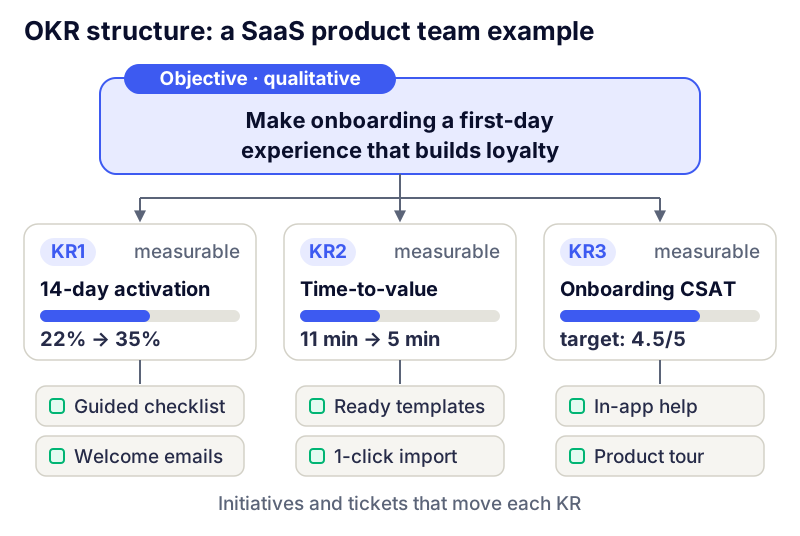
Example 1 — SaaS product team
O: Make onboarding a first-day experience that builds loyalty.
KR1: Lift the 14-day activation rate from 22% to 35%.
KR2: Cut median time-to-value from 11 min to 5 min.
KR3: Reach a post-onboarding CSAT of 4.5/5.
Example 2 — Marketing team
O: Become the go-to reference for roadmap management.
KR1: Triple organic traffic on "roadmap" pages.
KR2: Earn 40 backlinks from domains with DR > 50.
KR3: Grow the newsletter from 3,000 to 8,000 subscribers.
OKRs vs KPIs vs MBOs
| OKR | KPI | MBO |
|---|---|---|---|
Purpose | Frame an ambitious direction for a cycle | Track ongoing health of an activity | Cascade annual goals to individuals |
Horizon | Quarter (typically) | Continuous | Year |
Owner | Team / company | Activity / process | Often individual, tied to compensation |
Tied to comp? | Best avoided | Variable | Frequently yes |
How to write a good OKR?
A 4-step mini-method:
Start from a problem or opportunity: never invent OKRs just to have OKRs. You're trying to change something.
Phrase the Objective in one sentence: no number, memorable, value-oriented.
Define 2 to 4 Key Results: each with a baseline, a target and a date. At least one KR should be an outcome, not a deliverable.
Test the OKR out loud: if the team can't repeat it without reading, simplify.
For more on why OKRs matter, read why use OKRs.
Common mistakes
Confusing Key Result with task: "ship feature X" is not a KR.
Stacking 10 OKRs per team: focus evaporates.
Tying OKRs to bonuses: it pushes teams to aim low.
Skipping the review cadence: an OKR without a weekly/monthly ritual is a dead OKR.
Copying someone else's OKRs: without context they engage no one.
To compare tools, see the 5 best OKR tools in 2026.
Frequently asked questions
What does OKR mean exactly?
OKR stands for "Objectives and Key Results": a qualitative, inspiring Objective paired with 2 to 4 measurable Key Results that prove the Objective has been reached.
What's the difference between an OKR and a KPI?
A KPI tracks the ongoing health of an activity (e.g. conversion rate). An OKR sets an ambitious target for a cycle (often a quarter), and Key Results measure whether you hit it. The same metric can be a daily KPI and a Key Result when you're trying to move it.
How many OKRs per team?
Ideally 2 to 3 Objectives per team and per cycle, each with 2 to 4 Key Results. Beyond that, focus dilutes and prioritization gets fuzzy.
Should you hit 100% of your OKRs?
No. Google's OKR culture considers a 0.7/1 score healthy: it means the goal was ambitious enough. Hitting 100% systematically usually means goals were too soft.
Do OKRs work for small teams?
Yes — provided you stay simple: one team Objective, 2-3 Key Results, monthly review. OKRs are a focus tool, not an admin ritual.