Roadmap template: 6 formats with real product roadmap examples
Compare 6 roadmap templates (timeline, Now/Next/Later, themes, OKR, project, public) with filled-in product roadmap examples, use cases and common pitfalls.
By the RoadmapHero team · Updated on · 7 min read
Key takeaways
- A roadmap template is a reusable structure that decides how work is shown: on a calendar, by confidence horizon, by theme or by goal.
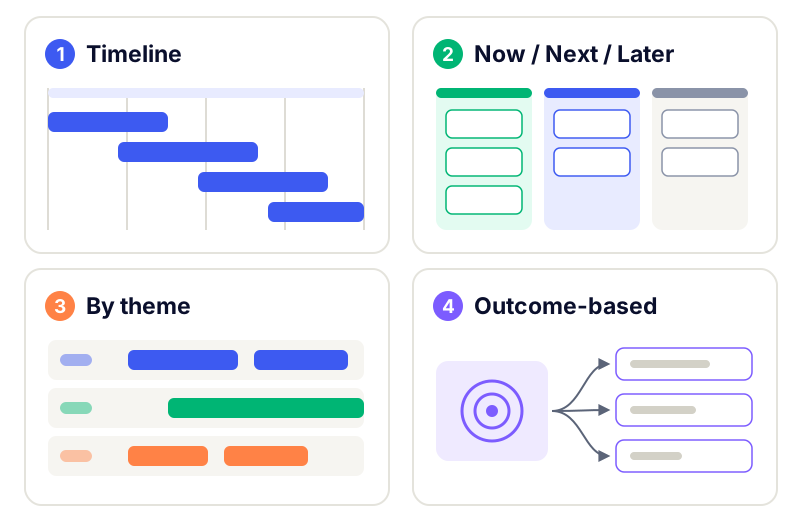
- Six formats cover most needs: timeline, Now/Next/Later, theme-based, outcome-based (OKR), project roadmap and public roadmap.
- The right template depends on three factors: who reads it, how far ahead it looks, and how uncertain the scope and dates really are.
- Most product teams run two views from the same data: a detailed internal view by goals or themes and a simplified external view.
A roadmap template is a ready-to-fill structure that determines how you present upcoming work: on a timeline, in confidence horizons, by theme or by goal. There is no universal best template. A timeline fits a fixed-date project, a Now/Next/Later roadmap fits a product that evolves continuously, and an outcome-based roadmap fits a team run on OKRs. Below you will find six formats, each with a filled-in product roadmap example, when to use it and the traps to avoid.
What is a roadmap template?
A roadmap is the visual translation of a strategy over a given horizon. The template is the frame: the columns, the rows and the information expected for each item. Whatever the format, a solid roadmap template always includes five things:
a goal or problem that justifies every item;
a time horizon, precise or deliberately fuzzy;
roadmap items: initiatives, themes or milestones, never tasks;
an owner for each item;
a status or confidence level.
If you are starting from a blank page, our step-by-step guide on how to create a roadmap covers the full process. This article focuses on picking the format.
1. Timeline roadmap template
When to use it. When dates are real and non-negotiable: a commercial launch, a compliance deadline, a planned migration, a contractual commitment. It also reassures audiences used to calendars, such as finance or partners.
What it contains. Bars on a time axis (months or quarters) with a start, an end and sometimes milestones. Example for a B2B scheduling app:
Initiative | Start | End | Status |
|---|---|---|---|
Enterprise SSO | January | February | Contract commitment |
Mobile app v1 | February | April | In progress |
Billing overhaul | March | May | Planned |
Accounting export | May | June | To be confirmed |
Pitfalls. Every date becomes a promise, and every slip cascades into the next items. Keep exact dates for real deadlines and show the rest by month or quarter. Where a timeline roadmap ends and an execution plan begins is covered in our Gantt chart vs roadmap comparison.
2. Now/Next/Later roadmap template
When to use it. For a product under continuous development, when scope and timing are uncertain beyond a few weeks. It has become the default for many SaaS product teams.
What it contains. Three columns that express confidence rather than dates. Example for an expense management tool:
Now: receipt scanning on mobile, one-click approval for managers.
Next: shorten reimbursement time (problem chosen, solution open), payroll software integration.
Later: multi-currency support, automatic duplicate detection.
Pitfalls. Turning the columns into disguised quarters (Now = Q1, Next = Q2) or letting Later become an idea graveyard. Our complete guide to the Now-Next-Later roadmap explains when items should move between columns.
3. Theme-based roadmap template
When to use it. When you need to show how effort is split across big areas, for instance to a leadership team asking how much energy goes to acquisition, retention or reliability. It pairs well with a quarterly horizon.
What it contains. One swimlane per theme, each with its rationale and a few initiatives.
Theme | Why it matters | Initiatives |
|---|---|---|
Onboarding | New accounts stall before first value | Guided checklist, one-click import |
Collaboration | Teams still coordinate over email | Comments, mentions |
Reliability | Incidents erode trust | API monitoring, export queue rebuild |
Integrations | Customers enter data twice | CRM connector |
Pitfalls. Too many themes (past six, nobody can read it) and themes that are really team names. A theme describes a customer or business problem, not an org chart. For a worked example over 90 days, see our quarterly roadmap guide.
4. Outcome-based (OKR) roadmap template
When to use it. When the team is measured on impact rather than output, and the company runs on OKRs. It is the template that best protects against becoming a feature factory.
What it contains. Measurable objectives on top and, under each, initiatives framed as replaceable bets. Example with illustrative numbers:
Objective | Key result | Bets |
|---|---|---|
Make new customers self-sufficient | 14-day activation from 32% to 40% | Guided checklist, starter templates |
Keep SMB customers longer | Monthly churn from 3% to 2% | Usage alerts, monthly admin report |
Speed up enterprise sales | Sales cycle from 90 to 60 days | SSO, audit log |
Pitfalls. Fake outcomes ("launch the mobile app" is an output, not an outcome) and goals you cannot measure because nothing is instrumented. The difference between the two models is unpacked in outcome-based roadmap vs feature roadmap.
5. Product roadmap vs project roadmap
People mix these up all the time, yet they serve different purposes.
Criteria | Product roadmap | Project roadmap |
|---|---|---|
Purpose | Evolve a product over time | Deliver a defined scope |
Unit | Goals, themes, initiatives | Phases, milestones, deliverables |
Horizon | Ongoing, reviewed each quarter | Bounded by an end date |
Key question | Why and what? | What, when and who? |
Project roadmap example for a CRM migration: scoping and vendor selection (month 1), data migration and configuration (months 2–3), sales team training (month 4), cutover and legacy shutdown (month 5). Each phase ends with a signed-off milestone.
Pitfalls. Running a product like a project (with an end date that does not exist) or a project like a product (without milestones or dependencies). The full method is in our guide on how to create a project roadmap.
6. Public roadmap template
When to use it. To show customers and prospects that the product is moving, collect their reactions and cut down on repetitive questions to support and sales.
What it contains. Simple columns without exact dates, written in the customer’s language. Example:
Under consideration: scheduled exports, offline mobile mode.
Planned: payroll software connector.
In progress: new team dashboard.
Shipped: single sign-on (SSO), dark mode.
Pitfalls. Publishing dates you cannot keep, exposing sensitive strategic bets, or leaving the page untouched for months, which sends the opposite signal of what you intended. See our public product roadmap guide for the best practices.
Roadmap templates compared
Format | Best for | Main audience | Dates |
|---|---|---|---|
Timeline | Fixed deadlines, launches | Executives, partners | Exact |
Now/Next/Later | Continuous product development | Teams, stakeholders | None |
Theme-based | Showing effort allocation | Leadership team | By quarter |
Outcome-based | OKR-driven teams | Executives, product teams | By quarter |
Project roadmap | Defined scope and end date | Project managers, sponsors | Milestones |
Public roadmap | Customer transparency | Customers, prospects | None or vague |
How to choose the right roadmap template
Start with the audience. Executives want goals and trade-offs, the team wants detail on what comes next, customers want to know whether their problem is on the list.
Gauge the uncertainty. The less certain the scope, the further you should move away from dates.
Check whether you have measurable goals. If you run OKRs, the outcome-based template is the most consistent choice.
Cap it at two views. One detailed internal view, one simplified external view, both fed by the same data so they never contradict each other.
In practice, formats mix well: a theme-based roadmap displayed as Now/Next/Later, or an outcome-based roadmap with one real deadline flagged on the initiative it affects.
Listen to the question your audience asks most often. "When?" calls for a timeline, "Why?" for an outcome-based roadmap, and "What's next?" for Now/Next/Later. Build the view that answers it first.
Whichever template you pick, the discipline around it matters more than the layout. Review it on a fixed cadence (monthly for the detail, quarterly for the direction), remove items that no longer serve a goal, and write down why each change happened. A plain template maintained this way beats an elaborate one that nobody has touched since the last planning offsite.
From a static template to a living roadmap
A spreadsheet or slide template is fine to get started, but it drifts out of sync with the backlog within weeks. In RoadmapHero, the same data can be displayed on a configurable time scale (from weeks to years) or as automated Now/Next/Later, and each ticket can be linked to an objective and key result. You switch formats without retyping anything. To try these views on your own data, sign up for free.
Frequently asked questions
What is the best product roadmap template?
There is no single best template. For a product under continuous development, Now/Next/Later or an outcome-based roadmap usually works best because neither locks the team into uncertain dates. A timeline template still makes sense for fixed-date projects. Pick the format based on your audience, your planning horizon and how much uncertainty surrounds scope and timing.
What should a product roadmap template include?
A product roadmap template should include goals or problems to solve, a time horizon, high-level items such as initiatives or themes, an owner for each item and a status or confidence level. Tasks, detailed estimates and user stories belong in the backlog, not on the roadmap, otherwise the document becomes unreadable for stakeholders.
Is a free Excel or PowerPoint roadmap template good enough?
A spreadsheet or slide template is good enough for a first version or a one-off presentation. The limits show up quickly: manual updates, multiple versions circulating, and no link to the backlog or to goals. Once the roadmap is reviewed monthly and shared with several audiences, a dedicated tool prevents those gaps from growing.
What is the difference between a product roadmap and a project roadmap?
A product roadmap evolves a product over time with no end date, organized around goals, themes and initiatives that are reviewed regularly. A project roadmap delivers a defined scope by an end date, organized around phases, milestones, deliverables and dependencies. The first answers why and what; the second answers what, when and who.
Can you combine several roadmap formats?
Yes, and it is common. A theme-based roadmap can be displayed as Now/Next/Later, and an outcome-based roadmap can flag a real deadline on a specific initiative. What matters is that every view is built from the same underlying data, so the internal and external versions never end up telling different stories.