Quarterly roadmap: how to build one in an afternoon (with example)
Build a quarterly roadmap in 6 steps: goals, themes, simple scoring, a capacity check and Now/Next/Later communication. Includes a filled-in example to copy.
By the RoadmapHero team · Updated on · 8 min read

Key takeaways
- A quarterly roadmap connects 2 to 3 measurable goals to the initiatives meant to reach them, grouped into a few themes, over a 12 to 13 week horizon.
- A quarter is short enough for priorities to stay reliable and long enough to ship initiatives that actually move a metric.
- Quarterly product planning fits in one afternoon: retro, goals, themes, impact/effort scoring, a capacity check, then Now/Next/Later communication.
- A quarterly roadmap stays useful thanks to two scheduled reviews: a mid-quarter check to adjust scope and an end-of-quarter review to measure results.
A quarterly roadmap is a 90-day product plan that ties 2 to 3 measurable goals to the initiatives that should achieve them, grouped into a handful of themes stakeholders can read at a glance. It sits in the sweet spot between long-term vision and day-to-day reality: short enough to be trustworthy, long enough to give direction. You can build one in a single afternoon if you follow a clear sequence.
This guide covers the definition, a six-step method, a filled-in example, the review cadence that keeps the plan alive, and the mistakes that quietly kill it.
What is a quarterly roadmap?
A quarterly roadmap is a view of your product roadmap scoped to one quarter. It answers three questions, in this order: what outcomes do we want this quarter, which themes will we work on to get there, and in what sequence.
It does not replace strategy or the backlog. It sits between them: strategy and the annual roadmap set direction, the quarterly roadmap picks the next leg of the journey, and sprints execute it. If you are still fuzzy on how a roadmap differs from a list of tickets, start with our guide on how to create a product roadmap.
Horizon | What it decides | Level of detail | Review cadence |
|---|---|---|---|
Annual roadmap | Direction and big bets | Themes | Every quarter |
Quarterly roadmap | Goals and priority initiatives | Initiatives, by month | Mid-quarter and end |
Sprint (2 weeks) | Work to ship | User stories, tasks | Every sprint |
Why is a quarter the right planning horizon?
Beyond three months, estimates turn into fiction: the market moves, customer feedback piles up, the team changes. Below that, there is not enough time to ship a meaningful initiative and see whether it worked. A quarter also matches how most companies already run: OKRs, board updates, sales targets and budget reviews tend to follow the same rhythm. Planning product work on that cadence saves you from translating between calendars every few weeks.
The underrated benefit is that a quarter forces trade-offs. With roughly 12 to 13 weeks of capacity, you cannot do everything. A quarterly roadmap makes those choices explicit instead of letting them happen by accident.
How to build a quarterly roadmap in 6 steps
1. Run a quick retro on last quarter
Spend 30 minutes looking back before looking ahead. Which goals did you hit? Which initiatives slipped, and why? What new customer signals showed up? This retro stops you from blindly rolling over what did not work, and it surfaces unfinished work that will eat capacity whether or not anyone replans it.
2. Start from goals, not features
Every quarterly roadmap starts with 2 to 3 measurable goals, ideally your OKRs for the quarter. Anything that does not contribute to them becomes secondary. A good quarterly goal describes an observable change ("raise 14-day activation from 32% to 40%"), not a deliverable ("ship the new onboarding"). The full mechanics are covered in how to align your roadmap with OKRs.
If an initiative does not map to any of this quarter's goals, it is not a priority, it is a distraction. Keep it in the backlog, not on the roadmap.
3. Group the work into themes
Instead of a list of 40 tickets, group the work into 4 to 6 themes stakeholders can understand without knowing the product in detail. A theme is a stable problem area, for example:
Acquisition and onboarding
Retention and activation
Tech debt and reliability
Monetization and expansion
Internal team productivity
Give each theme 1 to 3 initiatives, no more. Themes keep the roadmap stable even as initiatives change: you swap an initiative, the theme stays.
4. Prioritize with simple scoring
You do not need a heavyweight model to arbitrate a quarter. An impact vs effort score works: rate each candidate initiative from 1 to 5 on expected impact on the goals and on effort, then start with quick wins and high-impact bets. The value vs effort matrix walks through the method. Save RICE for high-stakes calls, such as two large initiatives competing for the same team.
5. Check the plan against real capacity
This is the step teams skip most often, and the one that sinks the most roadmaps. Compute available capacity (people × weeks, minus time off, support and rituals), then allocate it. A common rule of thumb: about 70% on quarterly goals, 20% on maintenance and tech debt, 10% buffer for the unexpected. If the selected initiatives exceed capacity, cut one now rather than hoping. Our guide to capacity planning for product teams shows the math step by step.
6. Communicate in Now / Next / Later
Present the roadmap in three columns: what is in progress, what comes next, and what comes later. It is the most honest format because it signals intent and order without promising exact dates. For internal audiences who think in months, you can show initiatives by month within the quarter, but keep the bars wide and own the uncertainty. The Now-Next-Later roadmap has its own in-depth guide.
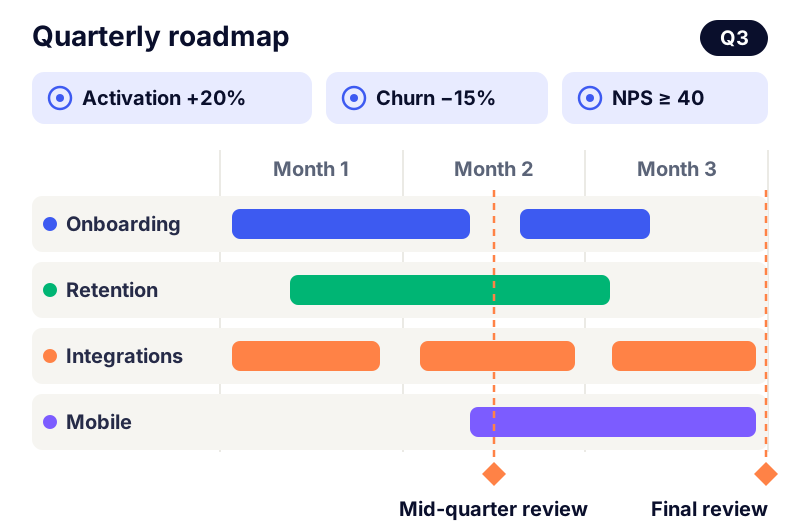
Quarterly roadmap example
Here is an illustrative example for a B2B SaaS company with around 15 people in product and engineering. Three goals for the quarter: G1, raise 14-day activation from 32% to 40%; G2, reduce monthly churn among SMB accounts; G3, cut critical incidents in half.
Theme | Initiative | Goal | Timing |
|---|---|---|---|
Acquisition and onboarding | Guided setup checklist | G1 | Month 1 |
Acquisition and onboarding | One-click data import | G1 | Month 2 |
Retention and activation | Usage alerts for inactive accounts | G2 | Months 2–3 |
Retention and activation | Automated monthly report for admins | G2 | Month 3 |
Tech debt and reliability | Rebuild the export processing queue | G3 | Months 1–2 |
Tech debt and reliability | API monitoring and alerting | G3 | Month 1 |
Notice what is missing: no day-level dates, no orphan initiative, and at most two initiatives per theme. Every row earns its place by pointing to a goal. To decide what belongs in the tech debt lane, see our guide on how to prioritize technical debt.
Keeping it alive: the two quarterly reviews
A quarterly roadmap is not something you write in week one and forget. Two scheduled check-ins are enough to keep it honest.
Mid-quarter review (around week 6 or 7): how are the metrics trending, which initiatives slipped, should you drop one to protect the goals? Thirty to sixty minutes with the product, design and engineering leads.
End-of-quarter review: did you hit the goals, and what did you learn? This review feeds straight into step 1 of the next quarter.
Adjustments in between are normal. Moving an initiative from Now to Next is not a failure; it is the roadmap doing its job. What matters is that stakeholders hear about each change from you rather than discovering it on their own. If you have to walk leadership through those trade-offs, our guide on how to present your roadmap to executives helps you structure the conversation.
Common quarterly planning mistakes
Too many goals. Past three, the team spreads thin and nothing gets fully done.
A roadmap filled to 100%. With no buffer, the first production incident pushes the whole quarter back.
Features instead of outcomes. "Ship X" is not a goal. Always ask which metric X is supposed to move.
Day-level dates. They turn estimates into promises, and broken promises into lost credibility.
No reviews on the calendar. If the mid-quarter check is not booked in advance, it never happens.
Ignoring carry-over. Unfinished initiatives from last quarter still consume capacity; plan for them from day one.
Building your quarterly roadmap in RoadmapHero
In RoadmapHero, the roadmap view has a configurable time scale, from months to quarters or years, plus automated and customizable Now/Next/Later. You define objectives and key results and link tickets to them, and HeroScore ranks initiatives in real time based on objectives, stakeholders, effort and confidence. Cycles then let you check the capacity of the sprints that make up the quarter. You can try RoadmapHero for free to plan your next quarter.
Frequently asked questions
What should a quarterly roadmap include?
A quarterly roadmap should include 2 to 3 measurable goals, 4 to 6 themes, a few initiatives per theme linked to a goal, a rough sequence by month or by Now/Next/Later, and the dates of the mid-quarter and end-of-quarter reviews. Owners and success metrics for each initiative help, but day-level dates and task lists belong in the backlog, not on the roadmap.
Should a quarterly roadmap have exact dates?
Generally no. Day-level dates turn estimates into commitments you will struggle to keep. Use Now/Next/Later or a month-level view instead, which communicates intent and priority. The exception is real external deadlines, such as a regulatory date or a contractual commitment, which should be flagged explicitly on the initiative they affect.
How many goals should a product team set per quarter?
Two to three at most. Beyond that, focus disappears and the team makes partial progress on everything without fully achieving anything. Each goal should be measurable, with a baseline and a target, and every initiative on the roadmap should map to at least one of them. It is better to fully succeed at three things than to start eight.
What is the difference between a quarterly roadmap and OKRs?
OKRs define what you want to achieve this quarter: a qualitative objective and quantified key results. The quarterly roadmap describes how you plan to get there: the themes, the initiatives and their order. They work as a pair. OKRs act as the filter for prioritization, and the roadmap shows the bets you picked to hit them.
What if the quarterly roadmap slips mid-quarter?
Do not stretch the quarter or hide the delay. At the mid-quarter review, identify the initiative that contributes least to the goals and drop it or move it to Next. Then explain the decision to stakeholders. Protecting the goals is better than delivering the whole plan late, and it keeps your roadmap credible for the next quarter.