How to prioritize technical debt (without stalling your roadmap)
Learn how to prioritize technical debt: log it in the backlog, rank it with an impact vs cost matrix, protect capacity for it, and win over stakeholders.
By the RoadmapHero team · Updated on · 8 min read

Key takeaways
- Technical debt is the future cost of shortcuts taken in code, architecture, tests or infrastructure. You pay the interest in slower delivery, more incidents and higher risk.
- To prioritize it, rate each debt item on two axes: its impact on delivery or risk, and its cost to fix. Fix high-impact, low-cost items first; plan the high-impact, high-cost ones.
- A common rule of thumb is to reserve a fixed share of every sprint for debt, often 15–20% of capacity, instead of waiting for a cleanup sprint that never happens.
- With business stakeholders, frame debt as cost of delay: days lost per sprint, incidents avoided, time to market. Never frame it as "messy code."
To prioritize technical debt, treat it like any other product investment: log it in the backlog, estimate what it costs you every sprint, rank it by impact versus cost to fix, and give it an explicit slice of team capacity. Debt that slows delivery or creates real risk goes first. Debt sitting in a module nobody touches can wait, sometimes forever.
The problem is almost never that debt exists. Every team that ships accumulates some. The problem is that it stays invisible until a simple feature takes three sprints, or an outage reveals that a critical component has no tests. This guide gives you a repeatable way out of that cycle, from inventory to prioritization to the conversation with leadership.
What is technical debt?
Technical debt is the gap between the current state of a system and the state that would let you change it quickly and safely. Ward Cunningham coined the term in the early 1990s as a financial metaphor: a shortcut lets you ship faster today (the principal you borrow), but every future change costs a bit more (the interest) until you pay it back.
The metaphor earns its keep because it makes two points. First, borrowing isn't wrong in itself. A startup validating its market is right to cut corners. Second, what matters is the interest, not the principal. Debt in code that nobody ever changes costs almost nothing.
Deliberate vs accidental debt
Martin Fowler's technical debt quadrant is the classic way to think about where debt comes from. In practice, the key distinction is between two origins:
Deliberate debt: the team knowingly takes a shortcut to hit a deadline and plans to come back to it. It's healthy as long as it's tracked and repaid.
Accidental debt: it builds up without anyone deciding to take it on, through gaps in knowledge, changing requirements, or simply a system that outgrew its design. It's the most common kind, and the hardest to spot.
The four main types of technical debt
Code debt: duplication, oversized functions, unclear naming, business logic scattered across files.
Architecture debt: tightly coupled modules, a monolith that blocks independent deploys, a database choice that no longer fits the load.
Test debt: thin coverage on critical flows, flaky tests, no end-to-end tests.
Infrastructure debt: outdated dependencies, frameworks past end of life, manual deploys, weak observability.
The biggest efforts, like a framework migration or breaking up an architecture, often deserve a technology roadmap of their own. This guide focuses on everyday debt, the kind you handle sprint by sprint.
How do you make technical debt visible?
Debt that isn't in the backlog doesn't exist as far as prioritization is concerned. So step one is to log it in the same place as all other work, using a shared format. For each item, capture at least:
the symptom, in words a non-engineer can follow
the affected area (module, service, user flow)
the interest you pay today: time lost, incidents, workarounds
the risk if nothing changes: security, compliance, outages, data loss
a rough estimate of the cost to fix, in t-shirt sizes or story points
The interest field matters most. It turns a team complaint into a prioritization argument. Write it as cost of delay: "every change to the billing module takes about two extra days, and we make one per sprint," or "this component caused three incidents this quarter." Cost of delay is the core of WSJF prioritization, and it fits debt remarkably well.
The natural place to add and update this inventory is backlog refinement. Engineers flag the debt they ran into during the sprint, and the product manager helps size its impact.
Prioritize with an impact vs cost matrix
Once debt is logged, a simple grid covers most cases. It crosses two axes: impact on delivery speed or risk (vertical) and cost to fix (horizontal). It's a debt-specific take on the value vs effort matrix.
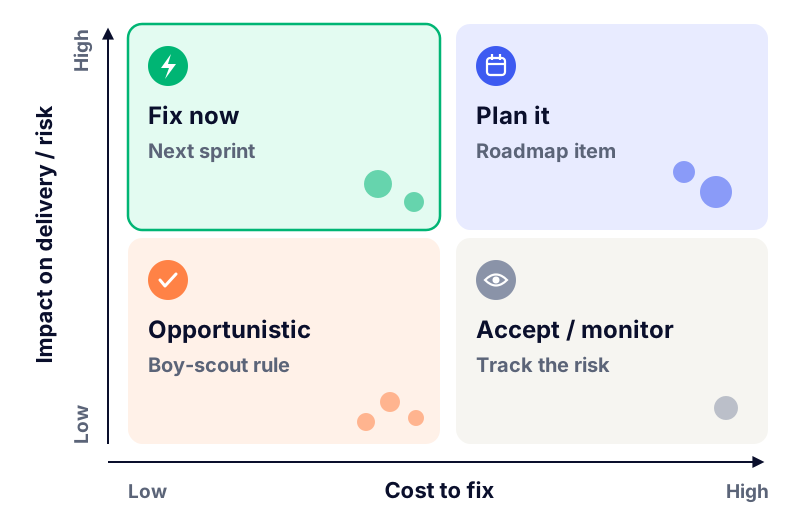
Quadrant | Impact | Cost to fix | Decision |
|---|---|---|---|
Fix now | High | Low | Next sprint, no debate |
Plan it | High | High | Dedicated initiative, sliced and scheduled |
Opportunistic | Low | Low | Boy-scout rule, as you go |
Accept / monitor | Low | High | Document it, review each quarter |
A few tips for getting the grid right:
Judge impact against the roadmap. Debt in a module the roadmap will lean on heavily next quarter moves up in impact, even if it only bites occasionally today.
"Plan it" items need slicing. A six-week effort should be broken into shippable steps, each with a measurable gain. Otherwise it will never win a trade-off against a feature.
The boy-scout rule means leaving the code a little cleaner than you found it. That's enough for opportunistic debt, as long as it stays within the scope of the current task.
Accepting debt is a legitimate call. What matters is that it's a conscious, written decision you revisit periodically.
To rank debt alongside features in a single list, tie each item to an objective (delivery speed, reliability, security) and score it with the same method you use for everything else. This guide on how to prioritize your backlog compares the main options.
How much capacity should go to technical debt?
There's no universal number, but a few rules of thumb come up again and again on product teams. Adjust them to the age of your product and the state of the codebase.
Reserve a fixed share of every sprint. 15–20% of capacity is a common starting point. Protect it: it doesn't get sacrificed to the first sales emergency.
Flex it based on system health. A young product might get by with around 10%. An older one with frequent incidents might need 30% or more for a while, until things are back to a sustainable level.
Fund big efforts as initiatives. "Plan it" debt won't fit in a 20% reserve. It belongs on the roadmap, with an objective and a target date.
Skip the one-off "cleanup sprint." It feels good but doesn't change how fast debt piles up, and it's the first thing canceled when a deadline looms.
Build this reserve into your capacity math from the start, as covered in the guide to capacity planning for product teams. A team that plans 100% of its capacity on features has effectively decided never to pay down its debt.
Don't create a hidden "side lane" where debt is handled outside normal prioritization. It always gets defunded at the first tough trade-off. Keep debt in the same backlog and defend it with the same kind of arguments as everything else.
How do you get business stakeholders on board?
Sales leaders and executives aren't against paying down technical debt. They just can't see what they're buying. "Refactor the payments module" tells them nothing. Translate each item into consequences they care about:
Time to market: "Billing changes take twice as long as anything else. The three customer requests waiting on billing will ship faster once this is done."
Risk: "This library is no longer maintained. If a vulnerability shows up tomorrow, we'd have no patch."
Recurring cost: "The team loses about two days per sprint on workarounds. That's roughly one feature per quarter."
Perceived quality: "This component drives most of the support tickets about exports."
Then present a choice, not a request: "Here's what we ship with 20% of capacity on debt, here's what we ship without it, and here's what skipping it will cost in six months." Explicit trade-offs land far better than unexplained slowdowns.
Which metrics should you track?
Measuring debt directly is hard. Measuring its effects is much easier. Pick three or four indicators and track them over time rather than building an exhaustive dashboard. Alongside your usual product metrics and KPIs, consider:
lead time: how long a ticket takes from start of work to production
deployment frequency and change failure rate, two of the metrics popularized by the DORA research program
production incidents per month and their time to resolution
share of capacity eaten by unplanned work (bugs, emergencies, workarounds)
average age of debt items in the backlog
actual share of each sprint spent on debt, compared with the planned share
If lead time drops and unplanned work shrinks while you invest steadily in debt, you have your case for the next trade-off discussion.
Managing technical debt in RoadmapHero
In RoadmapHero, debt can live in the same backlog as features, with its own ticket type and workflow. HeroScore lets you score it on the same weighted criteria (objectives, effort, confidence) as the rest of the backlog, and sprint capacity tracking helps you protect the share you reserved. The backlog health dashboard also surfaces ticket age, which makes forgotten debt easier to spot. You can sign up for free to try this setup with your team.
Frequently asked questions
What is technical debt in simple terms?
Technical debt is the future cost of shortcuts taken while building software. Like financial debt, it helps you move faster at first, but it charges interest: every later change becomes slower, riskier or more expensive. It can live in code, architecture, tests or infrastructure, and it isn't necessarily a mistake as long as it's chosen deliberately and tracked.
How do you balance technical debt and new features?
Put debt in the same backlog as features, estimate its cost of delay (time lost, incidents, risk), and score it with the same method. Rank it on an impact versus cost-to-fix matrix. On top of that, reserve a fixed share of every sprint for debt so it doesn't keep getting pushed back by the next feature request.
What percentage of a sprint should go to technical debt?
There's no standard, but a common rule of thumb is 15–20% of each sprint's capacity. A young product may need only about 10%, while an older product with frequent incidents may temporarily need 30% or more. Large efforts, like migrations or architecture changes, should be funded separately as roadmap initiatives.
How do you explain technical debt to executives?
Talk about business consequences, not code quality: time to market, security or outage risk, time lost every sprint, and support tickets generated. Put a number on the interest, even a rough one, then present an explicit choice between capacity scenarios. Executives accept a clear trade-off much more readily than an unexplained slowdown in delivery.
Who owns technical debt, the product manager or engineering?
Both. Engineering identifies debt, estimates the cost to fix, and raises risks. The product manager brings those items into prioritization, weighs them against features, and defends the reserved capacity with stakeholders. Debt managed by engineering alone, with no product visibility, usually ends up sacrificed.