How to present a roadmap to executives (with a 5-slide structure)
How to present a roadmap to executives: a 5-slide structure, what leadership expects, how to handle date pressure and objections, plus a 30-minute agenda.
By the RoadmapHero team · Updated on · 8 min read

Key takeaways
- An executive roadmap presentation fits in 5 slides: objectives and context, results since last review, next bets and why, risks and trade-offs, decisions needed.
- Executives want measured outcomes, explicit trade-offs, owned risks and clear decision requests — not a list of features or a detailed Gantt chart.
- When asked "when will it ship?", give a range and a confidence level that match the horizon, and never commit to a date for work that hasn't been estimated.
- A cadence that works for most companies is a 30–45 minute quarterly review plus a one-page monthly update in between.
To present a roadmap to executives, tell a short story in five parts: the objectives, the results so far, the next bets, the risks and trade-offs, and the decisions you need from the room. Leadership doesn't want to see your backlog; they want to know whether product investment is serving the strategy and what is being asked of them. Aim for 30 minutes, with at least a third of it spent on discussion and decisions.
Most roadmap reviews that go badly don't fail from lack of content but from too much of it: thirty features, an unreadable timeline, and one question about dates that eats the whole slot. This guide gives you a structure that holds up, answers to the hard questions, and a prep routine that fits on a checklist.
What do executives actually want from a roadmap review?
An executive roadmap review is a steering meeting. Leadership uses it to check that product resources are serving company goals and to make the decisions that go beyond the product team's authority. It is not a demo and it is not a sprint review.
Executives are looking for four things:
Outcomes. What moved in the metrics since the last review? Shipped features are only the means.
Explicit trade-offs. What you chose to do and, more importantly, what you chose not to do, and why.
Owned risks. What could go wrong, how likely it is, how much it would hurt, and what you're doing about it.
Decision requests. Budget, hiring, a choice between two options, a conflict between two departments: whatever you can't settle on your own.
That's why an outcome-based roadmap presents far better than a feature list — it speaks leadership's language. If your roadmap is still organized around features, our guide to outcome-based vs feature roadmaps will help you reframe it.
The 5-slide roadmap presentation structure
Five slides are enough for a 30-minute review. Everything else goes in the appendix, ready to pull up if someone asks.
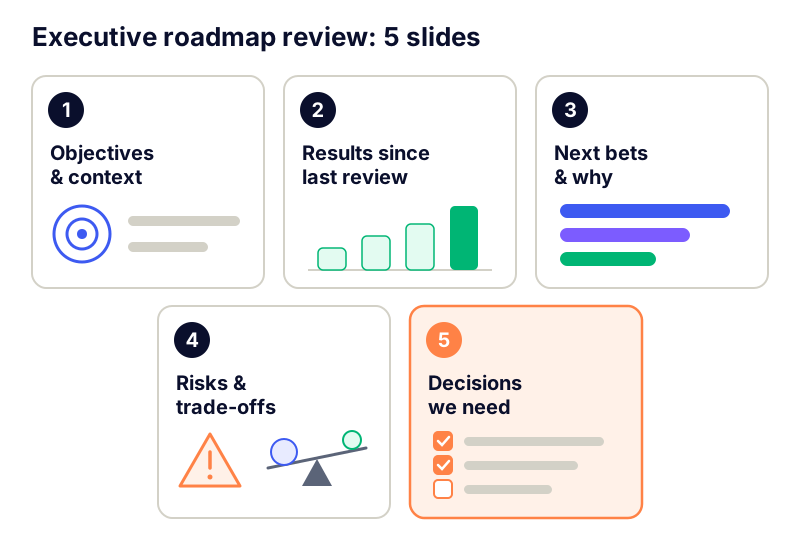
Slide 1 — Objectives and context
Restate the two or three company objectives the roadmap serves, ideally as OKRs, and what has changed since the last review: a competitor move, a regulation, a key departure. One sentence each. This slide anchors everything that follows; every initiative you show later should map back to it.
Slide 2 — Results since last review
Show movement in the metrics, not a list of closed tickets. A format that works: a small table with objective, baseline, current value and target, plus one line of interpretation. Be candid about what didn't work. A disappointing result explained clearly builds credibility; a dressed-up one collapses at the first follow-up question.
Slide 3 — Next bets and why
Present three to five major initiatives for the next period. For each one, give the problem it targets, the objective it supports and the evidence behind it (usage data, customer feedback, a sales opportunity). Call them "bets": the word signals that the outcome isn't guaranteed. A horizon-based format like a Now-Next-Later roadmap keeps you from locking in premature dates.
Slide 4 — Risks and trade-offs
List the top three risks (technical dependency, capacity, adoption, compliance) with a mitigation for each. Then show what you gave up: "We're not doing X this quarter so the team can focus on Y." Executives respect an owned trade-off far more than a roadmap that pretends to do everything.
Slide 5 — Decisions we need
This is the most important slide and the one most often skipped. Frame each request as a yes/no question with your recommendation: "We recommend moving the partner integration to next quarter to protect the retention goal. Do you approve?" If you have no decision to ask for, question whether the meeting is needed at all or whether a written update would do.
How to answer "When will it be done?"
This question always comes, and it's a fair one: executives commit sales, marketing and sometimes customers based on your dates. The problem isn't the question. It's giving the same kind of answer for work at very different levels of maturity.
Match your precision to the horizon:
Now (in progress or about to start): a date or a tight range, with high confidence, because scope is defined and estimated.
Next (coming months): a month or a quarter, with medium confidence and the assumptions it depends on.
Later (further out): an intent and a rough size, no date, because the problem hasn't been explored yet.
When the pressure builds, bring the conversation back to the three real levers: scope, date and resources. At constant capacity, pulling a date in means cutting scope, so offer options instead of absorbing the constraint silently. To show what the team can realistically take on, rely on up-to-date capacity planning.
If someone asks for a date on unestimated work during the meeting, don't improvise. Offer to come back within 48 hours with a range and its assumptions. A date said out loud in an executive meeting becomes a commitment.
Handling common objections
The same objections come up review after review. Prepare your answers in advance:
"Why aren't we building the feature that customer asked for?" Show where it sits in your prioritization, which criteria put it there, and what would have to drop for it to move up.
"Our competitor just shipped this." Go back to the customer problem: does that feature address a need your own data confirms among your customers?
"Why is this late?" Give the real cause in one sentence, the impact on the objective and the recovery plan. Don't blame another team.
"This is too vague." Separate what's vague because it's underprepared (fix it) from what's deliberately open because discovery isn't finished (own it).
"Can't we just squeeze in this one small thing?" Yes, if you name what comes out. Every addition without a removal dilutes the roadmap.
The posture that works: firm on the method, open on the conclusions. You're defending how choices were made, not your ego.
How often should you present the roadmap to leadership?
A common and effective cadence combines two rhythms:
A quarterly review of 30 to 45 minutes with the leadership team, aligned with your objectives cycle, to review results and make the calls for the next period. If you plan by quarter, our quarterly roadmap guide covers how to build the plan itself.
A monthly one-page update between reviews: three metrics, what changed on the roadmap and why, and any new risks.
Add an extra session only when a major change requires a decision before the next review. Other audiences such as sales, support and customers need a different format and rhythm; see our tips for communicating with stakeholders.
What to prepare before the review
The quality of the review is decided before the meeting starts:
Refresh the data. Objective progress and initiative status should be current as of the day before, not last week.
Send a pre-read. The five slides, 48 hours ahead, so the meeting is spent discussing rather than discovering.
Pre-wire key people. Talk one-on-one with executives directly affected by a trade-off; nobody should learn in the room that their project slipped.
Build the appendix. Initiative details, date assumptions, prioritization method: everything someone might ask for, without presenting it.
Anticipate three hard questions, with a short answer for each.
In RoadmapHero, key result tracking, a roadmap you can view by quarter or as Now/Next/Later, and item health status (delayed, moved, new) give you most of slides 2 to 4 from the same source your team uses every day.
Sample agenda for a 30-minute roadmap review
Time | Segment | Goal |
|---|---|---|
0–3 min | Objectives and context | Refocus on what matters |
3–8 min | Results since last review | Show impact, not activity |
8–13 min | Next bets and why | Explain choices and their link to goals |
13–18 min | Risks and trade-offs | Make the sacrifices visible |
18–28 min | Decisions we need | Get a yes, a no, or an owner |
28–30 min | Wrap-up | Read back decisions and next steps |
Notice the split: a third of the time is reserved for decisions. If the presentation runs long, cut from the results section, never from the decisions.
Pre-presentation checklist
Every initiative shown maps to an objective on slide 1.
Results are expressed as metrics, with a baseline and a target.
At least one trade-off is named explicitly.
Every date comes with a confidence level.
The top three risks each have a mitigation and an owner.
Every decision request is a yes/no question with a recommendation.
The pre-read went out 48 hours in advance.
People affected by a trade-off have been told beforehand.
A written summary of decisions will go out within 24 hours.
To go deeper on connecting objectives and initiatives, read how to align your roadmap with OKRs. And if you'd like to prepare your next review from a roadmap linked to your objectives, you can create an account.
Frequently asked questions
How many slides should a roadmap presentation to executives have?
Five slides are enough for a 30-minute review: objectives and context, results since last review, next bets, risks and trade-offs, and decisions needed. Initiative details, date assumptions and prioritization methods belong in the appendix. Beyond seven or eight slides, discussion and decisions usually get squeezed out by the presentation itself.
Should an executive roadmap include dates?
Yes for work in progress, with a range and a confidence level. For the coming months, a month or quarter is enough. For work further out, show an intent without a date. Matching precision to maturity prevents fragile estimates from turning into commitments the team can't keep.
What's the difference between a team roadmap and an executive roadmap?
They draw on the same data at different levels of detail. The team roadmap goes down to epics and dependencies. The executive roadmap stays at the level of objectives, major bets, risks and trade-offs. Ideally the executive version is a view of the team roadmap, so you never maintain two versions that drift apart.
What should I do if leadership imposes a delivery date?
Treat the date as a constraint, then show what it implies. With fixed resources, a fixed date is paid for in scope, so present two or three options, such as a reduced version on the requested date or the full version later, along with their consequences. Let leadership choose knowingly and record the decision.
How often should you present your roadmap to leadership?
A quarterly review with the leadership team, aligned with the objectives cycle, plus a one-page monthly update works for most organizations. Add an extra session only when a major change requires a decision before the next review. Presenting more often tends to turn the review into operational status tracking.