Leadership & strategy execution
Strategic alignment: how to align teams with strategy
Strategic alignment for leaders: spot the symptoms of misalignment, pull the 3 levers that align teams with strategy, and measure alignment with a checklist.
By the RoadmapHero team · Updated on · 8 min read

Key takeaways
- Strategic alignment is the state where every team's priorities, decisions and resources serve the same company objectives, and everyone can explain how their work contributes.
- Misalignment shows up in concrete symptoms: conflicting priorities, strategy changes discovered by accident, projects with no objective, and endless sync meetings.
- Three levers align teams with strategy: a few shared objectives, visible and explained priorities, and the same information for everyone at the same time.
- Alignment can be measured: the priority recall rate, share of work linked to an objective, share of capacity on priorities, and how fast a change of direction reaches teams.
Strategic alignment is the state in which every team in a company works on priorities that serve the same objectives, and anyone can explain in one sentence how their work contributes. To align teams with strategy, you need three levers: shared objectives, visible priorities, and the same information for everyone. Everything else is maintenance, done through a handful of well-chosen rituals.
Nobody decides to become misaligned. It creeps in: a priority gets reworded, a legacy project never gets stopped, half the people in a meeting are looking at last month's version of the plan. This guide shows you how to spot misalignment, why it happens, and how to fix it in a way that lasts.
What is strategic alignment?
Strategic alignment is the match between what the company decided to do and what its teams actually do. It has two dimensions:
Vertical alignment: from the executive team down to individual teams, people understand the strategy and connect their work to company objectives.
Horizontal alignment: across departments and teams, priorities are compatible. Product, sales, marketing and customer success are not pulling in opposite directions.
Alignment is not the same as agreement, and it is not compliance. An aligned organization argues, sometimes hard, before a decision, then commits once it is made. Alignment is also what makes autonomy possible: when the direction is clear, teams can choose the "how" without asking for permission at every step. This is often called aligned autonomy.
Alignment is also different from execution. Strategy execution is the full system of cascade, governance rituals and metrics, covered in our strategy execution guide. Alignment is its precondition. Without it, even great governance ends up steering teams that each head in their own direction.
What are the symptoms of misalignment?
Misalignment rarely shows up on an org chart or in a strategic plan. You see it in day-to-day work. The most common signs:
"Where are we on...?" is the most-asked question of the week.
Every leadership meeting opens with twenty minutes of catch-up.
Two teams discover they are working on conflicting initiatives, or on the same one.
Teams find out about a change in priorities by accident, often weeks after the decision.
A large share of in-flight projects cannot name a single company objective.
Managers spend part of their week compiling status reports whose numbers do not match.
Sales promises customers features that are not on the plan.
One or two of these are normal in a growing company. Beyond that, the cost is real: resync meetings, rework after every change of direction, projects started and then abandoned.
Why teams drift: the telephone game
In the telephone game, a sentence whispered from ear to ear is unrecognizable by the end of the line. Organizations work the same way. Take a direction set by the executive team on Monday: "This quarter's priority is signing 10 enterprise accounts. Anything that does not serve that goal waits."
Tuesday, the leadership recap reads: "This quarter: focus on enterprise, while keeping other topics going in parallel where possible."
Thursday, at the team meeting: "We'll do some enterprise work, but let's finish what's in progress first."
Friday, in the company chat: "I heard we're redoing onboarding?"
Nobody lied or sabotaged anything. Each relay did what relays always do. They compressed the message to make it shorter, interpreted it through their own constraints, and copied it into a new format that from then on ages on its own. Add time lag: by the time the message reaches the last level, the decision may already have changed.
This is why simply communicating more does not work. An annual all-hands or a CEO email will not survive six months of rewording. The fix is to cut the number of relays: a single, current source that anyone can check directly, plus information pushed to each audience in the terms that matter to them.
The 3 levers of strategic alignment
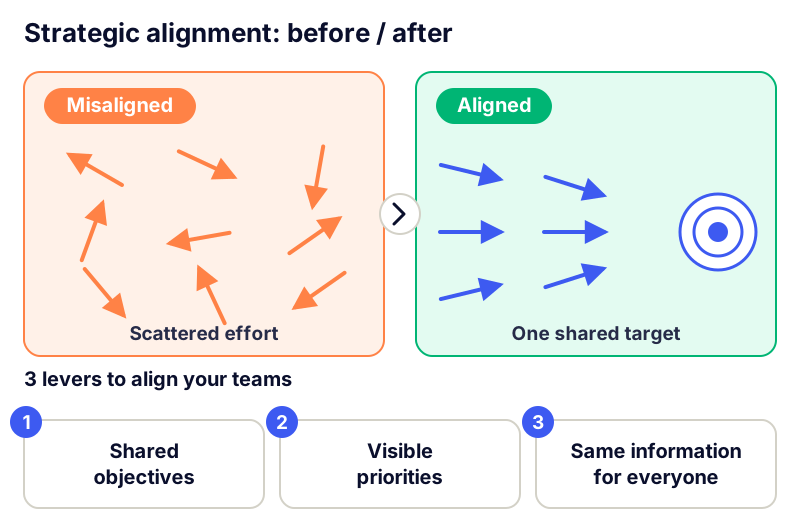
1. A few shared objectives
A team can only align with an objective it knows, understands, and that does not change every week. Stick to three strategic priorities and a small number of measurable company objectives. OKRs are a good format, as long as they are built together: part of the objectives should come from teams, not only from the top. Our guide to rolling out company OKRs explains how to run that two-way process.
2. Visible, explained priorities
Objectives are not enough if trade-offs stay opaque. Every team should see what is prioritized, what will wait, and above all why. Explicit prioritization criteria tied to objectives let everyone understand why their topic comes before or after another. An outcome-based roadmap makes that link readable, where a feature list hides it.
3. The same information for everyone
The third lever is the one most often neglected. As long as each department keeps its own version of the plan in its own slides, the telephone game goes on. The goal is a single version of the plan and its progress, with each audience seeing it in the right shape: executives see objectives and milestones, teams see the detail, sales sees what it can announce.
Run a recall test. Ask ten people from different levels and departments to name the company's top three priorities for this quarter. If you get more than three different answers, start with the first lever. If the priorities are known but their consequences are not, work on the second.
Self-assessment checklist: is your organization aligned?
Answer yes or no to each statement, honestly, for how your organization works today:
This quarter's company priorities fit on one page, with three priorities at most.
Every member of the executive team would phrase them the same way.
Every in-flight project is linked to an identifiable company objective.
Teams know the criteria behind the latest trade-offs.
A change in priorities reaches every affected team within a week.
There is one current version of the plan and its progress.
Managers do not hand-copy status reports for leadership.
Cross-team dependencies are identified before projects start, not during.
Teams can flag an objective as unrealistic, and that has changed an objective before.
Sales and support know what is shipping before customers do.
Rule of thumb: eight or more yes answers means your alignment is solid and mostly needs upkeep. Five to seven means fog is setting in and already costing time. Fewer than five means your company is playing telephone; start with levers 1 and 3.
Rituals that keep teams aligned
Alignment is not a one-off project. It erodes as soon as you stop maintaining it. A few rituals are enough, as long as they actually happen:
Ritual | Cadence | Who | What it aligns |
|---|---|---|---|
Strategy and objectives briefing | Yearly, then quarterly | Whole company | Direction and priorities |
Objective co-creation | Quarterly | Leadership and team leads | Objectives, top-down and bottom-up |
Cross-team dependency review | Monthly | Team leads | Horizontal priorities |
Progress note per audience | Weekly | Each audience | Shared information |
Objective check-in | Weekly | Each team | Day-to-day work |
The most underrated ritual is the weekly note. Short, written from what actually shipped and tailored to each reader, it replaces a large share of sync meetings. The principles in our tips for communicating with stakeholders apply well beyond product teams.
How do you measure strategic alignment?
What you do not measure quietly degrades. Four simple indicators give a reliable picture:
Priority recall rate: the share of people surveyed who correctly name this quarter's priorities. Measure it every quarter on a sample.
Share of work linked to an objective: projects and tickets that can name the objective they serve. A large share of orphan work signals a broken cascade.
Share of capacity on priorities: team time actually invested in strategic priorities, compared with keeping the lights on and off-strategy work.
Propagation delay: the time between a leadership decision and the moment every affected team has adjusted its plan.
Put these indicators on your executive dashboard and watch the trend rather than the absolute value.
The two middle indicators are the hardest to track by hand. Tools like RoadmapHero make them visible by linking objectives to teams' projects and tickets, then sharing an up-to-date view with each audience, with no account needed to read it. If you want to see what that looks like for your organization, you can try RoadmapHero.
Frequently asked questions
What is strategic misalignment?
Strategic misalignment is the gap between what leadership decided and what teams actually do. It shows up as conflicting priorities between teams, projects with no link to objectives, changes of direction discovered late, and meetings spent resyncing. It rarely comes from bad intent. Most of the time, the strategy simply got distorted as it traveled through each level of the organization.
How do you align teams with strategy?
Pull three levers: set a few shared objectives built with teams, make priorities and trade-off criteria visible, and give everyone the same up-to-date information in a form suited to each audience. Then maintain alignment with a handful of recurring rituals, such as a weekly objective check-in and a progress note, and measure it every quarter.
What is the difference between vertical and horizontal alignment?
Vertical alignment connects the strategy set by leadership to the work of teams, so everyone understands the objectives and how they contribute. Horizontal alignment is about consistency across departments and teams: their priorities are compatible and their dependencies are anticipated. A company can be well aligned vertically within each department and badly misaligned between departments.
How do you measure strategic alignment?
Track four indicators: the share of employees who can name this quarter's priorities, the share of projects linked to an objective, the share of capacity actually spent on strategic priorities, and the delay between a leadership decision and teams adjusting their plans. Follow the trend quarter over quarter rather than chasing an absolute target.
Does strategic alignment reduce team autonomy?
No, it is the opposite. A clear direction lets leaders delegate more: when objectives and trade-off criteria are known, each team can decide the "how" on its own without escalating every choice. What kills autonomy is ambiguity, which forces more approvals. Alignment covers the "what" and the "why"; autonomy covers the "how".