Leadership & strategy execution
Annual strategic planning: a step-by-step process and calendar
Annual strategic planning, step by step: the 12-month calendar from strategic review to annual plan, budget and quarterly OKRs, who owns what, and pitfalls.
By the RoadmapHero team · Updated on · 8 min read

Key takeaways
- Annual strategic planning turns a multi-year strategy into 3 to 5 priorities for the year, measurable objectives, a budget, a portfolio of initiatives and quarterly OKRs.
- The cycle usually starts in late Q3 or early Q4 of the prior year: strategic review, annual objectives, department plans and budget, trade-offs, then sign-off.
- The annual plan sets direction and funding; quarterly OKRs turn it into measurable results and let teams adjust course without replanning the whole year.
- A plan stays alive through quarterly business reviews, a mid-year strategy refresh and reallocation rules agreed before the year starts.
Annual strategic planning is the process leadership uses to translate a multi-year strategy into a plan for the coming year: a few priorities, measurable objectives, a budget and a portfolio of initiatives. It follows a predictable calendar: strategic review in late Q3 or early Q4, department plans and budget in November, sign-off in December, then quarterly OKRs throughout the year. Done well, it produces a short plan everyone in the company can explain.
Done badly, it produces a 100-page binder approved in December and forgotten by February, plus a budget negotiated line by line with no link to strategy. This guide walks through the annual planning process: the calendar, each step, the inputs you need, who owns what, and how to keep the plan alive once the year begins.
What is annual strategic planning?
Several documents are involved, and mixing them up causes half of the arguments. Keep them distinct:
The strategic plan (often three to five years) sets the vision, positioning and big bets: which markets, which offerings, what level of ambition.
The annual plan, sometimes called the annual operating plan, translates that strategy into 3 to 5 priorities for the year, with measurable objectives and the initiatives meant to move them.
The budget allocates resources (headcount, investment, spend) to the annual plan. It is the financial expression of the plan, not its starting point.
Quarterly OKRs break annual objectives into three-month results for the company, departments and teams.
A useful way to remember it: strategy chooses, the annual plan prioritizes, the budget funds, OKRs execute. When the budget comes first, the year gets planned by rolling last year forward. For the full chain from vision to team work, see our strategy execution guide.
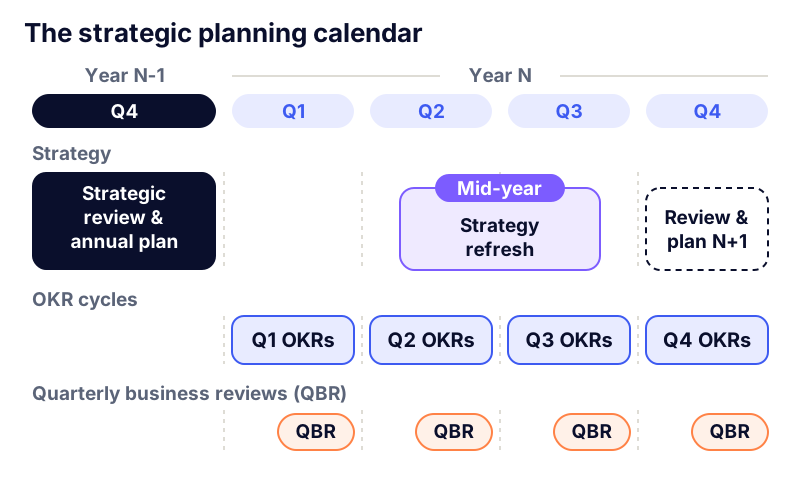
The annual planning calendar
For a fiscal year that matches the calendar year, the cycle starts in September of the prior year and runs through December of the plan year. If your fiscal year starts in another month, shift everything accordingly.
When | Step | Owners | Output |
|---|---|---|---|
September (prior year) | Strategic review | CEO, executive team, strategy lead | Diagnosis and 3 to 5 priorities |
October | Annual objectives and funding envelopes | Executive team, CFO | Target metrics, envelopes per department |
November | Department plans and budget | Department heads, finance, PMO | Plans, budgets, initiative portfolio |
December | Trade-offs and sign-off | Executive team, board | Approved annual plan and budget |
Every quarter | OKRs and quarterly business review | Departments and teams | Quarter's OKRs, review of the last one |
June–July | Mid-year strategy refresh | Executive team | Confirmed or adjusted priorities, reallocations |
As a rule of thumb, allow twelve to fourteen weeks from kicking off the strategic review to approving the plan. Less than that and departments cannot build serious plans; more and the exercise drags on until the context has changed.
The annual planning process in 5 steps
Step 1: run the strategic review
The strategic review looks back at the year and out at the context before deciding on the next one. Inputs to gather:
Year-to-date results: objectives hit or missed, initiatives delivered, planned versus actual in both time and money.
Market and competition: shifts in demand, new entrants, regulation.
Voice of the customer: churn reasons, recurring requests, feedback from sales and support.
Internal capacity: headcount, skills, technical debt, and commitments already made that will consume next year's capacity.
Risks: critical dependencies, suppliers, security, cash.
The output is not a report. It is a short list of 3 to 5 priorities for the year, each with its rationale, plus an explicit list of what the company will not do.
Step 2: set annual objectives and funding envelopes
The executive team turns each priority into one or two measurable objectives: revenue in a target segment, retention, time to onboard, margin. If you already have a North Star Metric, it can anchor the set. In parallel, finance proposes top-down envelopes per department that match the priorities. A priority with no resources is only a wish.
Step 3: build department plans and the budget
Each department builds its plan: initiatives that serve the objectives, estimated effort, hiring needs and dependencies on other departments. This is the bottom-up part of the process. The PMO or strategy office consolidates the plans into a single portfolio, which exposes duplicates, resource conflicts and objectives nobody is working on. Project portfolio management techniques help rank initiatives before trade-offs.
Step 4: make trade-offs and sign off
The sum of department plans almost always exceeds available resources. Trade-offs mean deciding what gets in, what waits and what is dropped, using criteria everyone knows: contribution to objectives, cost, risk and dependencies. The executive team then approves the annual plan and budget and, where governance requires it, takes them to the board. The same principles apply as when you present a roadmap to executives: lead with objectives, show what you are giving up, and ask for clear decisions.
Step 5: cascade into quarterly OKRs
The annual plan sets direction; OKRs make it executable. At the start of each quarter, the company picks the key results that will move the annual objectives this quarter, then departments and teams propose theirs. Our guide to a company-wide OKR rollout covers that cycle and the balance between top-down direction and bottom-up proposals.
Who does what in annual planning?
Planning often fails because roles are fuzzy. A typical split looks like this:
The CEO and executive team decide priorities, arbitrate resources and own the plan in front of the company.
The CFO and finance team set envelopes, consolidate the budget and check that ambition and resources match.
The strategy office or PMO runs the calendar, provides templates, consolidates department plans and prepares trade-offs. See what a PMO does and how to set one up.
Department heads build their department's plan and commit to objectives.
Teams estimate effort, flag dependencies and propose their OKRs.
The board, where there is one, approves the budget and major directions.
Name one owner for the process itself. Without one, each department moves at its own pace and the calendar slips by weeks.
How to keep the annual plan alive during the year
A plan approved in December is already partly wrong by March. That is not a failure; it is why adjustment mechanisms need to be designed in from the start.
Quarterly business reviews (QBRs): review the quarter's OKRs, check progress on annual objectives, and decide on next quarter. This is where real steering happens.
A mid-year strategy refresh: in June or July, the executive team confirms or adjusts priorities in light of the first half and any change in context.
Reallocation rules: agree in advance who can move how much budget or capacity without going back to the executive team. This prevents money from staying locked in initiatives that no longer make sense.
Continuous visibility: progress on each objective and on the portfolio should be visible at any time, not only in the monthly report. A one-page executive dashboard is enough.
A capacity reserve: keeping part of capacity unallocated, say 10 to 15% as a rule of thumb, lets you absorb the unexpected without breaking the plan.
In RoadmapHero, every initiative and ticket is linked to the objective and key result it serves, and progress flows up from the tools teams already use. When priorities shift, HeroScore weights can be changed in one click and priorities recalculate, with capacity tracked in person-days and in currency, estimated versus actual.
Annual planning pitfalls to avoid
The most expensive mistake is building the budget before the priorities. The budget then rolls last year forward with a few percent up or down, and the strategic plan becomes a cover memo.
Too many priorities: beyond five, nothing is a priority and trade-offs get made ad hoc throughout the year.
Too much detail: scheduling every project to the month for twelve months creates an illusion of control and makes every change expensive.
An endless process: when planning consumes all of Q4, execution of the current year suffers.
No link to real capacity: adding up initiatives without checking who will deliver them produces a plan that is unachievable by January.
A frozen plan: without quarterly reviews or reallocation rules, teams work around the plan instead of updating it.
An invisible plan: if teams cannot connect their work to an annual priority, they won't.
Checklist for your next planning cycle
The calendar is published before the end of summer, with a named process owner.
Year-to-date results are ready before the strategic review starts.
The plan fits on one page: 3 to 5 priorities, their objectives, and what you will not do.
Every budget line maps to a priority or to running the business.
Q1 OKRs are ready by mid-January.
All four quarterly reviews and the mid-year refresh are already on calendars.
To connect your annual plan to the work your teams actually do and track it all year, you can create an account.
Frequently asked questions
What is the difference between a strategic plan and an annual plan?
A strategic plan usually covers three to five years and describes the vision, target markets and major bets. An annual plan translates that strategy for a single year: three to five priorities, measurable objectives, the initiatives that serve them and the budget attached. The annual plan is rebuilt every year, while the strategic plan is revisited less often.
When should annual strategic planning start?
For a fiscal year that matches the calendar year, start the strategic review in September or early October. Allow twelve to fourteen weeks until the plan and budget are approved in December. Starting later forces rushed decisions, while starting much earlier means assumptions may be outdated by the time the new year begins.
Should the budget come before or after the annual plan?
After the priorities are set, and in parallel with department plans. The budget is the financial expression of the plan: it funds the priorities you chose. Building it first means rolling last year forward and then looking for a strategy to justify it. Indicative funding envelopes can still frame department plans early on.
How do annual plans connect to OKRs?
Annual objectives frame the quarterly OKRs. Each quarter, the company chooses the key results that will move the annual objectives, then departments and teams propose their own. Quarterly business reviews measure progress and let leadership adjust the next quarter without reopening the entire annual plan.
Who should own the annual planning process?
The executive team makes the decisions, but one owner should run the process: a strategy office, an enterprise PMO or the finance team, depending on the organization. That owner publishes the calendar, provides templates, consolidates department plans, prepares trade-offs and makes sure quarterly reviews actually happen during the year.