Leadership & strategy execution
Company OKRs: how to roll out OKRs across the whole company
How to implement company OKRs: a phased rollout plan, cascading vs aligning, top-down vs bottom-up, quarterly rituals, examples, and why to keep bonuses out.
By the RoadmapHero team · Updated on · 9 min read

Key takeaways
- Company OKRs are 3 to 5 objectives set by leadership for the whole organization, which every department and team links its own OKRs to.
- A successful OKR rollout is phased: a one-quarter pilot with the executive team and 2 or 3 volunteer teams, then an expansion department by department over 2 to 3 quarters.
- Align rather than cascade: leadership sets the direction and teams propose their key results, with a rule-of-thumb split of about 40% top-down and 60% bottom-up.
- Do not tie OKR scores to bonuses: teams start setting targets they know they can hit, and a steering tool turns into a performance-review tool.
To implement OKRs across the company, start small and grow deliberately: leadership sets 3 to 5 company objectives, a pilot quarter tests the system with a few teams, and each department then links its own OKRs to the company ones. The rollouts that stick run on a quarterly planning cycle and a short weekly check-in. The framework matters less than how the executive team uses it: OKRs that never drive a trade-off are usually dead within two quarters.
This guide is for CEOs, executive team members, and department heads who want OKRs to become the way the company steers, not a form-filling exercise. If you are new to the concept, start with what an OKR is, and for the craft of writing a good key result, see how to write good OKRs. Here we focus on the organizational side: who sets what, in which order, and at what pace.
What are company OKRs?
Company OKRs are qualitative objectives set by the CEO and executive team for the whole organization, each paired with 2 to 4 measurable key results that tell you whether the objective was met. What sets them apart from team OKRs is scope: no single team can achieve a company OKR on its own, which is exactly what makes it a cross-functional commitment.
Three traits define a good company OKR:
It is scarce. Three to five objectives for the entire company, not fifteen.
It turns strategy into outcomes. "Win the enterprise segment" says where you are going; "Sign 10 accounts worth over $50k each" says how you will know you got there.
It drives trade-offs. A company OKR that has never caused anyone to say no to a project is just a slogan.
Many organizations keep the objective annual and reset the key results each quarter, so the direction stays stable while the measurement adapts. Company OKRs sit between your vision and your project portfolio, a link we cover in depth in our strategy execution guide.
The OKR rollout plan, in four phases
Launching OKRs everywhere on the same Monday, with one company-wide training session and a spreadsheet template, is the fastest way to get hundreds of poorly written OKRs and a quiet abandonment. A phased rollout takes a little longer and saves a lot of credibility.
Phase 0: prepare (4 to 6 weeks)
Name an executive sponsor, ideally the CEO. OKRs live or die by how leadership uses them.
Appoint an OKR program owner, often called an OKR champion, who runs the cycle, trains people, and reviews quality without writing OKRs on teams' behalf.
Get clear on strategy. If the executive team cannot agree on three priorities, OKRs will not do it for them.
Set the ground rules: maximum number of objectives, scoring scale, no link to compensation, and the tracking tool.
Phase 1: pilot (one quarter)
Run the pilot with the executive team plus two or three volunteer teams, ideally from different functions: one product team, one sales team, one operations team. Leadership drafts three company objectives, and the pilot teams propose their own OKRs linked to them. The goal of this quarter is learning, not hitting targets: what is hard to measure, how long the rituals really take, where teams collide. Close with a retrospective and adjust the rules.
Phase 2: expand (two to three quarters)
Expand department by department rather than team by team at random. Each new department drafts its OKRs with the champion and someone from a pilot team. Accept imperfection: first-quarter OKRs are rarely well calibrated. What matters is that every department sees its OKRs discussed in reviews and used to make decisions.
The second quarter is usually the hardest. The launch energy has faded and the habits are not yet in place, so visible executive involvement matters more than ever.
Phase 3: embed (year two onward)
OKRs become the language of management. The annual plan flows from them (see our guide to annual strategic planning), quarterly business reviews are organized around them, and budgets follow the priorities they express. As a rule of thumb, expect three to four quarters before the system runs without constant effort.
Cascading vs aligning OKRs: how should levels connect?
Cascading means turning each key result at one level into an objective for the level below, floor by floor. On paper it is perfectly coherent. In practice it is slow (each level waits for the one above, so the bottom floor gets its OKRs halfway through the quarter), brittle (one change at the top invalidates everything beneath it), and demotivating (teams execute numbers they had no say in).
Aligning starts from the same company direction but flips the logic. Leadership publishes its objectives, then each department and team proposes the OKRs through which it can contribute most, explicitly linking each one to a company OKR. Consistency is checked in a joint alignment session rather than enforced by construction.
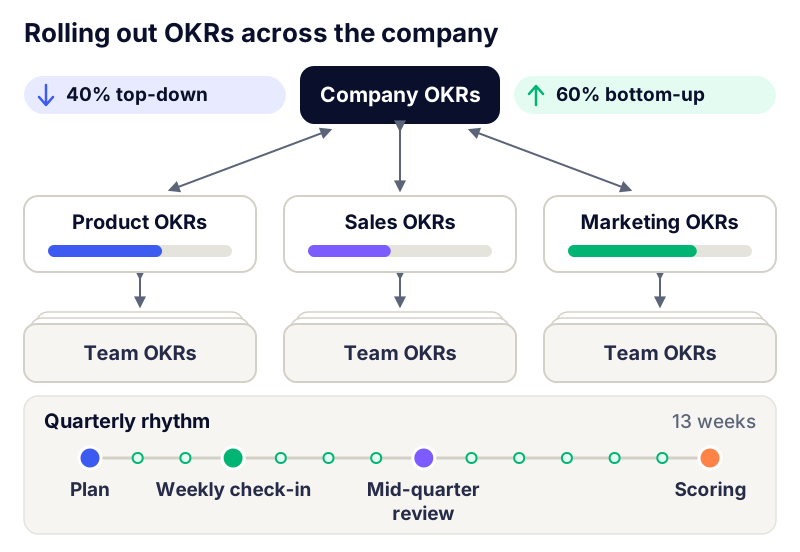
Two rules make alignment easy to read:
Every department or team OKR links to a company OKR, or is explicitly labeled as "run the business" work.
A company OKR with nothing linked beneath it is a red flag: nobody actually owns it.
Alignment is horizontal too. If a sales objective depends on a product capability, both OKRs should say so, and both departments should have talked before anything is approved. For how this plays out inside product teams, our guide to OKRs for product teams covers the path from key results to the roadmap.
Top-down or bottom-up: finding the balance
A fully top-down system produces compliance, not commitment. A fully bottom-up one produces a pile of local initiatives with no strategy. A widely used rule of thumb is roughly 40% top-down direction and 60% bottom-up proposals. In practice:
Leadership sets the company objectives and, for some of them, one or two non-negotiable key results such as a revenue figure or a security threshold.
Departments and teams propose their own key results and how they will get there.
Negotiation is about ambition and coherence, not wording.
A sign you have the balance right: ask any team why it is working on something, and it names the company OKR it serves and explains why it chose this particular approach.
OKR cadence and rituals: the quarterly cycle
An OKR system is only as good as its rituals. Here is a typical cycle for a company of 50 to 500 people:
Planning (2 to 3 weeks before the quarter). The executive team confirms or adjusts company OKRs, departments propose theirs, and a two-hour alignment session resolves dependencies and gaps.
Weekly check-in (15 to 30 minutes). Each team updates its key results with a confidence level; at the executive level, you only look at what changed and what is slipping.
Mid-quarter review (one hour). This is where you reallocate: stop an initiative that is not moving anything, reinforce an at-risk OKR, rewrite a key result that no longer makes sense.
Scoring and retrospective (last week). Each key result is scored, usually from 0 to 1; around 0.7 on an ambitious objective is a good outcome.
The executive weekly check-in is the ritual that makes or breaks the system. It has to be short and based on a live view, not on a report assembled the night before, which is the whole point of a good executive dashboard.
Company OKR examples
The examples below are for a fictional B2B company of about 200 people. Each objective is cross-functional: no single department can hit it alone.
Company objective | Key result 1 | Key result 2 | Contributing departments |
|---|---|---|---|
Win the enterprise segment | Sign 10 accounts worth over $50k each | Enterprise sales cycle under 90 days | Sales, product, security |
Customers succeed from day one | Onboarding completed in under 15 days | 80% of new customers active at day 30 | Product, customer success |
Customers who stay | Monthly churn below 1.5% | NPS from 20 to 40 | Customer success, support, product |
Profitable growth | Gross margin from 72% to 78% | Customer acquisition cost down 15% | Finance, marketing, operations |
A team that can keep up | 90% of key hires filled | Time to hire under 45 days | People, hiring managers |
None of these key results is a project. "Launch the new customer portal" is an initiative serving the second objective, and it belongs in the teams' plans. If your company has a North Star Metric, at least one company OKR should move it.
OKR governance: who does what?
The executive team sets company objectives, resolves resource conflicts, and looks at OKRs every week. Each company OKR has a named owner on the executive team.
The OKR champion runs the calendar, onboards newcomers, reviews quality (is the key result measurable, does it have a baseline?), and publishes a quarterly summary.
Department heads translate the direction for their area and own cross-department dependencies.
Teams propose their OKRs, keep them updated, and raise risks early.
Add two transparency rules: every OKR is visible to every employee, and any mid-quarter change is logged with its reason.
Common OKR rollout mistakes
Do not tie OKR scores to bonuses or individual performance reviews. Once pay depends on the percentage achieved, teams propose objectives they know they can hit, targets get negotiated down, and the system stops steering anything. Evaluate people on contribution, decision quality, and behavior, not on the score.
The other mistakes that most often derail a rollout:
Too many OKRs. Fifteen company objectives and five OKRs per team means nothing is a priority. Cut until it hurts.
OKRs that list projects. "Roll out the new CRM" is an initiative. Ask what will be different once it is done.
Ignoring "run the business" work. If most of a team's capacity keeps existing systems running, say so, or its OKRs will be unrealistic from week one.
Rituals that fade. OKRs set in January and reread in December steer nothing.
The tool becomes the goal. A spreadsheet is fine for a pilot; the tool should follow the practice, not the other way around.
Tracking OKRs without adding reporting overhead
Most rollouts lose momentum at the update step. If every team has to copy its numbers into a spreadsheet each week, the check-in becomes a chore and the data is stale by the time anyone reads it. The fix is to connect key results to the teams' actual work, so progress is observed rather than self-reported.
That is how RoadmapHero works: objectives and key results are linked to initiatives and tickets, teams keep working in Jira, Linear, or GitHub, and each objective's progress is calculated from what has actually shipped. Leadership gets an up-to-date view without manual reporting. To try it on your next OKR cycle, start with RoadmapHero.
Frequently asked questions
How long does it take to roll out OKRs across a company?
As a rule of thumb, plan for three to four quarters: a few weeks of preparation, a one-quarter pilot with the executive team and two or three teams, then two to three quarters of expansion department by department. OKRs usually feel natural in year two, once the annual plan and budget are built directly on them.
Should OKRs be tied to bonuses or compensation?
No. This is one of the most consistent recommendations from experienced OKR practitioners. Linking scores to pay pushes teams toward safe targets and turns quarterly planning into a negotiation, which strips OKRs of their ambition. Keep them as a steering tool, and evaluate people on their contribution, their decisions, and how they work with others.
How many company OKRs should you have?
Three to five company objectives, each with two to four key results. Beyond that, attention scatters and nothing is really a priority. The same logic applies to departments and teams: two or three objectives per quarter is enough, with an explicit share of capacity reserved for keeping the business running.
What is the difference between OKRs and KPIs?
A KPI continuously measures the health of an activity, such as revenue or churn rate. An OKR sets an ambitious change over a fixed period, combining a qualitative objective with measurable key results. They work together: when a KPI deteriorates, it can become the key result of an OKR for as long as it takes to fix it.
Should OKRs cascade down every level of the organization?
No. Strict cascading, where each key result becomes the objective of the level below, is slow and brittle. Alignment works better: leadership sets company objectives, then each department and team proposes OKRs explicitly linked to one of them. Not every team needs its own OKRs; some simply contribute to their department's.