Leadership & strategy execution
Strategy execution: how to turn strategy into results
Strategy execution guide for leaders: why strategies fail in execution, how to cascade from vision to team work, and which rituals and metrics to use.
By the RoadmapHero team · Updated on · 10 min read

Key takeaways
- Strategy execution is the system that turns strategic choices into results: a cascade of objectives, a fixed cadence of governance rituals, and a short list of shared metrics.
- Most strategies fail in execution, not design: too many priorities, budgets that never move, work disconnected from objectives, and a message that degrades at every level.
- A strategy cascades through five levels: vision, strategic priorities, company objectives, a portfolio of initiatives, and team work, with results flowing back up.
- Four rituals are enough to steer execution: a weekly team check-in, a monthly portfolio review, a quarterly business review, and an annual strategy review.
Strategy execution is the discipline of turning a strategy into results: translating a few strategic choices into objectives, funded initiatives and team work, then reviewing progress on a fixed cadence and reallocating resources when reality diverges from the plan. To execute strategy well, you need three things working together: a clear cascade, governance rituals that make decisions, and metrics that tell you early whether you are on course.
Most leadership teams do not lack a strategy. They lack the machinery that carries it from the offsite to the Tuesday afternoon decision a team lead makes about what to build next. This guide covers why execution breaks down, how to cascade strategy from vision to team work, which rituals to run, and which indicators to watch.
What is strategy execution?
Strategy execution is the continuous loop that connects three questions: where are we going (strategy), what are we doing to get there (initiatives and team work), and is it working (results). It is distinct from strategic planning, which produces the plan once a year, and from financial control, which tracks spend. Execution is what happens in between, every week.
A working strategy execution system has three components:
A cascade that translates the vision into priorities, measurable objectives, initiatives and team work, so every project can name the objective it serves.
Governance: recurring meetings with a fixed cadence where leaders look at results, make trade-offs and move resources.
A small set of metrics that are shared, current, and cover both outcomes and the health of execution itself.
Well-known frameworks such as the Balanced Scorecard, Hoshin Kanri, OGSM and OKRs are variations of this same system. They differ in vocabulary and formality, not in principle. The best framework is the one your organization will actually use every week.
Why do strategies fail in execution?
The failure modes are well known and remarkably consistent across industries. The strategy itself is rarely the problem. The system meant to carry it usually is.
Too many priorities
A strategy with ten priorities has none. When everything matters, each manager makes trade-offs by their own criteria and the company drifts in several directions at once without anyone deciding it. Richard Rumelt, in Good Strategy Bad Strategy, describes the kernel of a good strategy as a diagnosis, a guiding policy and coherent actions. In other words: choices, and therefore things you will not do.
Resources that never move
Annual budgets are often built by rolling forward last year's numbers. The strategy narrative changes, but headcount, budgets and hiring stay allocated to the same work. A priority without dedicated capacity is a wish.
A broken link between strategy and actual work
Between the strategic plan and team backlogs there is often a gap: projects launched without a stated objective, legacy initiatives nobody dares to stop, urgent requests that crowd out important ones. Until that link is explicit, nobody can say how much of the company's effort actually serves the strategy.
A message that degrades at every level
The direction set by the executive team gets rephrased in the leadership meeting, again in team standups, and again in Slack. At each hop it loses precision and gains interpretation. It is the telephone game, covered in depth in our article on strategic alignment.
Governance that reports instead of decides
Many steering meetings spend most of their time on status: twenty minutes of catch-up, slides built the night before and already out of date. No time is left for trade-offs. Yet executing strategy is a sequence of reallocations: stop this, accelerate that, push the other thing to next quarter.
Metrics that arrive too late
Revenue and margin tell you whether the strategy worked, but too late to correct course. Without leading indicators, the gap only shows up at year-end close.
How to cascade strategy from vision to team work
Cascading strategy means translating it, level by level, into something more concrete and shorter-term, all the way down to what teams are doing this week. Each level answers the "why" for the level below and the "how" for the level above.
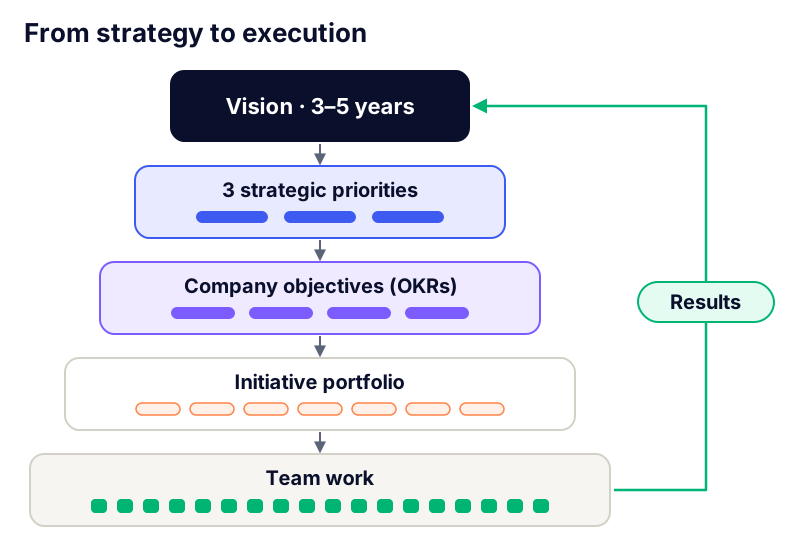
Vision sets the long-term destination: what the company wants to become, and for whom. It rarely changes.
Strategic priorities, three at most, turn the vision into multi-year bets: win a segment, productize the offer, improve unit economics. They also state what the company will not pursue.
Company objectives make those priorities measurable over the year and the quarter, often as OKRs. Our guide to rolling out company OKRs walks through the method.
The initiative portfolio groups the projects and programs funded to hit those objectives. Each initiative is tied to an objective, with an owner, a budget and a target date. This is where trade-offs happen; see our guide to project portfolio management.
Team work, meaning team roadmaps, backlogs and sprints, breaks each initiative into deliverables. Teams own the "how".
The most important arrow in the diagram is the one going up: results. A cascade that only flows down becomes a chain of command. Teams see the ground truth and must be able to say that an objective is unrealistic or that an initiative is not producing the expected effect. Hoshin Kanri calls this back-and-forth catchball: objectives go up and down the levels before they are locked.
Test your cascade from the bottom. Pick ten projects at random and ask their owners which company objective each one serves. If the answer takes more than one sentence, or there is no answer, the link is broken right there.
Levels, horizons, artifacts and rituals at a glance
Each level of the cascade has its own time horizon, reference artifact and governance ritual. Use the table below as a starting point and adjust the cadence to your size and market speed.
Level | Horizon | Artifact | Ritual |
|---|---|---|---|
Vision | 5 to 10 years | Vision and ambition statement | Annual strategy offsite |
Strategic priorities | 2 to 3 years | Strategic plan, 3 priorities max | Annual strategy review, mid-year refresh |
Company objectives | Year and quarter | Company and department OKRs | Quarterly business review |
Initiative portfolio | Quarter to year | Portfolio roadmap, budget, capacity | Monthly portfolio review |
Team work | Week to sprint | Team roadmaps, backlogs | Weekly check-in, sprint review |
Two rules follow. First, the lower the level, the faster the cadence: you do not revisit the vision every quarter, but you do not leave a backlog unreviewed for a month. Second, every artifact should link to the one above it. A team roadmap that does not reference a single company objective is a warning sign.
Governance rituals that actually move strategy forward
Effective strategic governance fits in four rituals. Resist adding more: every extra meeting is paid for with your best people's time.
Weekly team check-in (15 to 30 minutes)
Each team reviews progress on its objectives: what moved, what is blocked, and its confidence for the quarter. The point is not reporting. It is surfacing blockers early enough for the next level up to act.
Monthly portfolio review (60 to 90 minutes)
Leadership looks at the state of the portfolio: which initiatives are on track, at risk or late. This is where reallocation decisions get made: stop, accelerate, defer. A good portfolio review produces written decisions, not just minutes. Send a pre-read 48 hours ahead and spend at least half the meeting on trade-offs.
Quarterly business review (half a day)
The QBR scores the objectives of the past quarter, captures lessons and sets the next quarter's objectives. It is also the moment for a deeper portfolio reshuffle. When product or project leads present there, the structure in our guide to presenting a roadmap to executives keeps the session focused.
Annual strategy review (one to two days)
The executive team revisits the diagnosis, the priorities and the allocation of resources for the coming year. It feeds the annual strategic planning cycle. A mid-year refresh lets you correct course without waiting twelve months.
One rule applies to all four: every ritual ends with named decisions, an owner and a date. A meeting that changes neither priorities nor resource allocation is a status update, and a status update can almost always be replaced by a shared, current document.
Which metrics should you use to steer strategy execution?
A strategy execution dashboard combines two families of metrics: those that measure outcomes, and those that measure the health of execution. Most companies track the first family well and ignore the second.
Outcome metrics
Company objective progress: key result attainment with a status (on track, at risk, off track) and a trend.
A few leading indicators that predict the financials: activation, retention, sales pipeline, time to go live. A North Star Metric can act as the common thread.
Lagging financial metrics: revenue, margin and cash, which confirm or refute the strategy.
Execution health metrics
Share of capacity on strategic priorities, as opposed to keeping the lights on and off-strategy work. As a rule of thumb, if less than half of your discretionary capacity serves the priorities, the strategy is not really funded.
Share of work linked to an objective: how many projects and tickets can name the objective they serve.
Portfolio health: the split of initiatives between on track, at risk and late, and how it moves month over month.
Decision lead time: how long it takes between a risk surfacing and the corresponding trade-off being made.
Reallocation rate: how many initiatives were stopped, accelerated or deferred this quarter. A portfolio that never changes usually means governance that never decides.
Keep it to five to seven metrics on one page that every executive reads before each ritual. Our guide to building an executive dashboard offers a ready-made layout.
The hard part is not choosing these metrics but keeping them current without pulling managers into reporting every Friday. That is where tooling matters. In RoadmapHero, for instance, tickets are linked to key results and objective progress is calculated from what has actually shipped, with no manual reporting.
Where to start: a six-step plan
You do not need to rebuild everything at once. Here is a realistic sequence for one quarter:
Write down no more than three strategic priorities, including what the company explicitly will not do.
Turn each priority into two or three measurable objectives for the year, then for the current quarter.
Inventory the current portfolio and tie every initiative to an objective. Pause the ones that serve none.
Check that team capacity and budget match the priorities, and reallocate where they do not.
Put the four rituals in the calendar for the full year.
Publish a single view of progress that everyone can access, fed by real work rather than copied-over status reports.
Step 3 is usually the most uncomfortable and the most valuable. Within a few days it reveals how much effort serves no priority at all, which is your first pool of capacity to fund the strategy.
If you want to connect company objectives to your teams' actual work and give every audience an up-to-date view of progress, you can try RoadmapHero.
Frequently asked questions
What is the difference between strategic planning and strategy execution?
Strategic planning produces the plan: diagnosis, priorities, objectives and budget, usually once a year. Strategy execution keeps that plan alive all year long by tracking progress on objectives, spotting gaps early and organizing trade-offs through recurring rituals. A company can have an excellent plan and no execution system at all, which is exactly how a strategy ends up as a slide deck nobody opens.
Why do most strategies fail in execution?
The common causes are well documented: too many simultaneous priorities, budgets and teams still allocated to old work, projects with no link to objectives, a message that degrades as it travels down the organization, and governance meetings that review status instead of making decisions. The problem is rarely the strategy itself. It is the system that should translate it into action.
How many strategic priorities should a company have?
Three at most is a sound rule of thumb. Beyond that, priorities compete for the same people and budget, and managers end up making trade-offs on their own. A strategic priority should matter enough to justify saying no to something else. If no attractive opportunity has been turned down because of your priorities, they are probably not working as a filter.
Who is responsible for strategy execution?
The CEO and executive team remain accountable for strategy execution, but each company objective needs a named executive owner and each initiative an operational owner. A PMO or transformation office can run the rituals and consolidate metrics. It cannot replace executives in making trade-offs, which are the core of strategy execution and cannot be delegated.
What tools help with strategy execution?
A spreadsheet and well-run meetings are enough to start. As the organization grows, the main challenge becomes linking objectives to initiatives and team work without re-keying data. Look for a tool that ties initiatives to objectives, computes progress from actual delivery and shares an up-to-date view with each audience, rather than yet another reporting layer.