Project portfolio management: how to prioritize projects
Project portfolio management explained: how to prioritize projects with a scoring model, balance them against capacity, run reviews and stop projects.
By the RoadmapHero team · Updated on · 9 min read

Key takeaways
- Project portfolio management (PPM) is the practice of selecting, prioritizing and balancing all of an organization's projects so limited resources deliver the most strategic value.
- A project delivers an output, a program coordinates related projects toward a shared benefit, and a portfolio covers every investment to decide which ones get funded.
- To prioritize projects, score them on four to six weighted criteria, then start only what fits within your teams' real capacity, measured in person-days.
- A quarterly portfolio review must be able to stop projects. A portfolio that never kills anything is not being managed; it is just piling up.
Project portfolio management (PPM) is the discipline of deciding which projects to start, in what order, with which resources, and which ones to stop, so that the whole set moves the organization's strategy forward. Project management is about doing projects right; portfolio management is about doing the right projects. In practice it rests on three mechanisms: a scoring model to rank projects, a capacity line to decide what actually starts, and a recurring review that decides what comes in and what goes out.
You usually feel the need before you name it. Too many projects running in parallel. The same three experts pulled in by five sponsors. Zombie projects nobody dares to cancel. An executive team that discovers delays instead of making trade-offs. This guide walks through a complete approach, from the project scoring model to the one-page portfolio view your leadership team actually needs.
What is project portfolio management?
A project portfolio is the full set of projects and programs in an organization, or a division, that draw on the same budget and the same people. Managing it means continuously answering four questions:
Which projects actually serve our goals? (alignment)
In what order should we do them? (prioritization)
How much can we realistically run at once? (capacity)
Which projects should we slow down, reshape or stop? (governance)
A PMO typically runs the portfolio process, while decisions sit with a portfolio board or the executive team. If you don't have that function yet, our guide on what a PMO is and how to set one up compares the main models.
Portfolio vs program vs project: what's the difference?
These three words get used interchangeably, but they describe three different levels of decision-making.
Dimension | Project | Program | Portfolio |
|---|---|---|---|
Purpose | Deliver a defined output | Achieve a benefit shared by related projects | Maximize the value of all investments |
Time frame | Fixed start and end | Several months to several years | Ongoing, reviewed in cycles |
Core question | Are we doing the project right? | Are the projects moving together? | Are we doing the right projects? |
Led by | Project manager | Program manager | PMO and executive team |
Success measure | Time, cost, scope, quality | Benefits realized | Contribution to strategic goals |
For example: the ERP migration is a project. "Finance 2027," which bundles the migration, the new month-end close process and e-invoicing, is a program. Everything the company funds this year is the portfolio.
How to prioritize projects: criteria and a scoring model
Prioritizing projects without explicit criteria means giving priority to the loudest sponsor. A scoring model makes the trade-off debatable in the good sense: people argue about scores and weights, not about each other.
The most common project prioritization criteria:
Strategic alignment: direct contribution to a company goal or OKR.
Business value: revenue, cost savings, customer satisfaction, productivity.
Urgency: cost of delay, market window, external deadline.
Risk and complexity: technical uncertainty, dependencies, novelty for the team.
Effort: cost and workload in person-days.
Mandatory projects, such as regulatory work or replacing software that is going out of support, sit outside the scoring. They get funded first; the only question is whether they are run as lean as possible.
Here is a simple weighted scoring model with five criteria, each scored from 1 to 5. Risk and effort are inverted, so 5 means low risk or low effort.
Criterion | Weight | Project A: customer portal | Project B: HR automation |
|---|---|---|---|
Strategic alignment | 30% | 5 | 3 |
Business value | 25% | 3 | 4 |
Urgency | 15% | 4 | 2 |
Risk (5 = low) | 15% | 3 | 4 |
Effort (5 = low) | 15% | 2 | 4 |
Weighted score | 100% | 3.6 | 3.4 |
Project A wins narrowly despite the heavier effort, because of its strategic fit. A gap this small is mostly a signal that the decision deserves a real conversation: the model informs the call, it doesn't make it.
A few rules keep a scoring model honest:
Five criteria at most. Beyond that, scores cancel each other out and every project lands around 3.
Written scales. "Business value 5" should map to a concrete threshold, such as annual savings above a set amount.
Weights locked before scoring. Otherwise people tune the weights until their project wins.
If you want something lighter, WSJF divides the cost of delay by job size, and a value vs effort matrix is often enough for a first pass.
Balance the portfolio against capacity
This is the step most organizations skip. Once projects are ranked, you have to draw a line: above it, what fits in capacity; below it, what waits. Without that line, everything starts, everything crawls, and nothing lands on time.
How to do it:
Estimate each project's workload for the period, in person-days, by team or by skill.
Measure the capacity you really have, after run-the-business work (maintenance, support, time off).
Walk down the ranked list, adding up the workload until you hit capacity.
Keep a buffer. A common rule of thumb is to commit no more than 80 to 85% of capacity to absorb the unexpected.
Check scarce resources. If the same architect is needed on three top-ranked projects, that person sets the pace, not the budget.
Two principles make this stick. First, stop starting, start finishing: ten projects at 50% deliver no value, five finished projects do. Limiting work in progress shortens every project's duration. Second, make the cost of additions visible: every project accepted mid-quarter pushes another one below the line. Our capacity planning guide covers how to calculate available capacity.
In RoadmapHero, you can rank the portfolio by your own weighted criteria and immediately see what fits in the quarter's capacity in person-days; when priorities change, the capacity line follows.
Visualize the portfolio: the value vs risk bubble chart
A table of scores doesn't show whether the portfolio is balanced. A bubble chart does. Each project is a bubble placed by its strategic value and its risk or complexity, and the bubble size shows its budget.
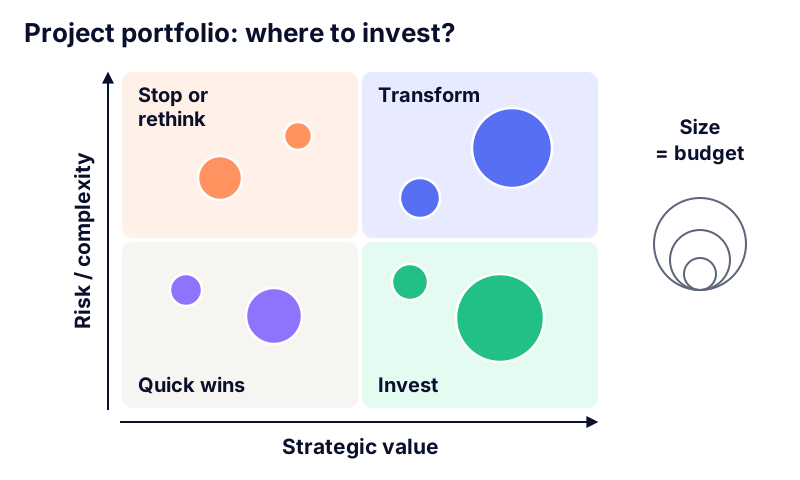
How to read the four quadrants:
Invest (high value, manageable risk): the core of the portfolio. Protect its resources.
Transform (high value, high risk): strategic bets. Break them into stages and watch them closely.
Quick wins (moderate value, low risk): useful for banking benefits early, as long as they don't swamp the teams.
Stop or rethink (low value, high risk): the natural candidates for cancellation or a reset.
What leadership should look for: lots of large bubbles in the high-risk zone mean the portfolio is overexposed; lots of tiny scattered bubbles mean it is fragmented. Cross-project risks, such as a vendor or an expert shared by several projects, also belong at this level. Our guide to project risk management explains how to score them.
How often should you run portfolio reviews?
A portfolio is managed through a cadence, not an annual exercise. A rhythm that works in many organizations:
Monthly review (45 to 60 minutes, run by the PMO): project health, critical risks, capacity gaps, escalations.
Quarterly review (portfolio board or executive team): trade-offs, new projects in, projects out, resource reallocation.
Annual review: budget allocation by strategic goal, tied to your annual strategic planning.
Between reviews, an intake gate prevents a pile-up. Every new project request goes through a one-page brief (problem, goal served, expected benefit, rough workload, sponsor) and is scored with the same model as the rest of the portfolio.
Set kill criteria when you launch a project: "if the pilot hasn't reached this adoption rate by the end of the quarter, we stop." A rule agreed on in advance makes the stop decision far less political when the day comes.
How to stop a project
Stopping a project is the hardest and most valuable decision in portfolio management. Every project kept alive without a reason ties up people who are needed elsewhere.
Signals that should put the question on the table:
the value hypothesis behind the project has been disproved
the strategic goal it served has changed or gone away
cost or schedule has drifted past an agreed threshold, with no credible recovery
the sponsor has left or stopped showing up
a cheaper alternative has appeared
The main obstacle is the sunk cost fallacy: "we've already spent $300k, we can't stop now." The only question that matters looks forward: if this project didn't exist, would we start it today, given what's left to spend?
A well-run stop is documented (the decision and why), captures what was learned, explicitly reassigns the people, and is announced clearly to the teams. Framed that way, stopping a project reads as good management, not failure.
The portfolio view for leadership
An executive team doesn't need project-level detail. It needs one page that answers five questions:
Where is the money going? Budget and capacity split by strategic goal.
How healthy are the projects? How many are on track, at risk and late, plus the two or three that need attention.
Do we have the capacity? Committed workload vs available capacity, for each critical team.
What's coming in and going out? New proposals, completed projects, stopped projects.
What decisions are needed? Framed as closed questions, with a recommendation.
That view should come from the live plan, not be rebuilt in a spreadsheet every month. For how to design it, see our guide to the executive dashboard. RoadmapHero, for instance, generates a view per committee, sponsor or business team from the same plan, shared by link with no account to create.
Common mistakes
Starting everything that gets approved. Approval is not a start date. Without a capacity line, everything slows down.
Scoring once and forgetting. Scores change when the context does; revisit them every quarter.
Confusing budget with capacity. A funded project without the right people available won't really start.
Never stopping anything. The portfolio swells, timelines stretch, and strategy gets diluted.
If you want to see your portfolio ranked by your own criteria and checked against real capacity, you can start a RoadmapHero workspace and import your projects.
Frequently asked questions
What is PPM in project management?
PPM stands for project portfolio management: the set of practices used to select, prioritize, balance and monitor all of an organization's projects. Its goal isn't to run any single project well, but to choose the right projects, start them in the right order given available resources, and stop the ones that no longer serve the strategy. It is usually run by a PMO with decisions made by leadership.
What is the difference between a program and a portfolio?
A program groups related projects that pursue a shared benefit, such as all the projects in a finance transformation, and it has a start and an end. A portfolio covers all of an organization's projects and programs, related or not, that share the same budget and people. A program coordinates delivery; a portfolio decides what deserves funding in the first place.
How do you prioritize multiple projects?
Pick four to six criteria, such as strategic alignment, business value, urgency, risk and effort, and weight them before scoring anything. Score each project from 1 to 5, compute a weighted score and rank the list. Then walk down the ranking, adding up workload until you reach available capacity. Whatever falls below that line waits for the next review.
How often should a project portfolio be reviewed?
A common cadence pairs a monthly review of 45 to 60 minutes, run by the PMO, to track project health and risks, with a quarterly review with leadership to make trade-offs, approve new projects and stop others. An annual review completes the cycle by allocating budget across the main strategic goals for the coming year.
When should you kill a project?
Consider stopping a project when its value hypothesis has been disproved, the goal it served has changed, cost or schedule has drifted past an agreed threshold, its sponsor has disappeared, or a cheaper alternative exists. The test is simple: would you start this project today, knowing what is left to spend? If the answer is no, stop it and reassign the team.