Project management: definition, phases, and methods explained
What is project management? Learn the 5 project phases, key roles, how Waterfall, agile and hybrid methods compare, and the classic reasons projects fail.
By the RoadmapHero team · Updated on · 10 min read
Key takeaways
- Project management is the practice of leading temporary, one-off work to a defined goal while balancing scope, time, cost and quality.
- Every project moves through 5 phases: initiation, planning, execution, monitoring and controlling (which runs alongside execution), and closure.
- The three main families of methods are predictive (Waterfall), agile (Scrum, Kanban) and hybrid, which plans milestones up front and delivers in iterations.
- Most projects fail for management reasons rather than technical ones: vague goals, scope creep, unrealistic schedules and risks spotted too late.
Project management is the discipline of planning, organizing and steering a temporary set of activities to reach a specific goal within an agreed timeline, budget and quality bar. In practice it runs through five phases (initiation, planning, execution, monitoring and controlling, closure) and relies on a delivery method, predictive, agile or hybrid, chosen according to how much uncertainty the project carries.
This guide covers the fundamentals every project manager, PMO lead and sponsor should share: what a project actually is, what happens in each phase, who does what, how to pick a method, which deliverables matter, and why so many projects go sideways. Each section links to a deeper guide if you want to go further.
What is project management?
A project is a temporary effort, with a start and an end, undertaken to create a unique result: a new app, an office move, an ERP migration, a market launch. That is what separates it from operations, which are ongoing and repetitive (running payroll, shipping orders). Project management is the work of turning that effort from an idea into a delivered outcome.
At its core sits a constant trade-off between four constraints, often drawn as the triple constraint or "iron triangle," with quality in the middle:
Scope: what the project will deliver, and what it explicitly won't
Time: the end date and the milestones along the way
Cost: the budget, in dollars and in person-days
Quality: the standard the result has to meet
Pull on one and the others move. Adding a feature without moving the date or adding people means quality drops, or the schedule becomes fiction. A project manager's real job is to make those trade-offs visible and get the right person to decide them at the right time.
What are the 5 phases of project management?
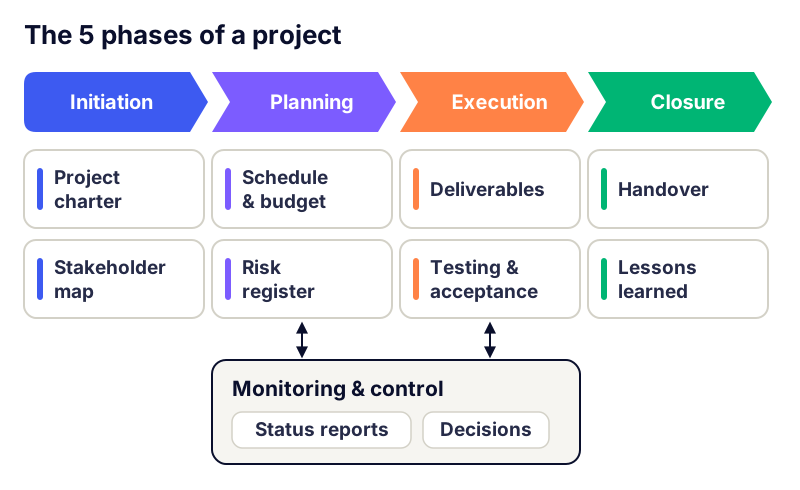
The project life cycle is usually split into five phases, based on the process groups popularized by the Project Management Institute (PMI). Companies use different labels, but the logic holds everywhere.
1. Initiation
Initiation answers three questions: why this project, what result, and within what limits? The output is a project charter that sets the objective, what is in and out of scope, constraints, assumptions, a ballpark budget, the sponsor and the success criteria. It is also when you map your stakeholders. A badly initiated project almost never recovers: every gray area turns into a conflict later.
2. Planning
Planning turns the goal into an actionable plan: a work breakdown structure (WBS), effort estimates, task sequencing and dependencies, the critical path, resource assignments, a detailed budget and a risk plan. When the end date is imposed from outside, you plan backward from the deadline. The full method is in our guide on how to create a project plan.
3. Execution
The team produces the planned deliverables: building, configuring, testing, training, communicating. The project manager coordinates, clears blockers, manages vendors and shields the team from out-of-scope requests. This is where most of the budget gets spent.
4. Monitoring and controlling
This phase doesn't come "after" execution; it runs alongside it from day one. It means comparing actuals against the plan (schedule, cost, scope), tracking risks, handling change requests and raising flags early. The main tools are a project status dashboard, weekly team check-ins and the project steering committee, where decisions beyond the team's authority get made.
5. Closure
Closure is the phase teams skip most often. It covers final acceptance of the deliverables, handover to the people who will run the result, releasing resources, closing the budget and a lessons learned review. Skip it and the organization repeats the same mistakes on the next project.
Who does what? The key project roles
Successful projects run on clear roles. Titles vary by company, but you will almost always find:
Sponsor: the executive who owns the business case, secures the budget and makes the major calls. Cross-functional projects without an engaged sponsor stall.
Project manager: accountable for delivery day to day. Plans, coordinates, tracks progress, manages risks and reports.
Project team: the people producing the deliverables, often drawn from several departments and rarely full time.
Stakeholders: anyone affected by the project or able to influence it, from end users to legal and finance.
Steering committee: the governance body that approves phase gates, resolves trade-offs and unblocks escalations.
PMO (project management office): the function that sets standards, provides tooling and rolls up project data across the company. Its remit varies a lot, as our guide on what a PMO is explains.
To remove ambiguity, map responsibilities in a RACI matrix: for each deliverable or decision, who is Responsible, who is Accountable (one person only), who is Consulted and who is Informed.
Which project management methodology should you use?
There is no universal method. The right choice depends mostly on how stable the requirements are and whether the result can be delivered in pieces.
Predictive (Waterfall)
The predictive approach runs phases in sequence: specify everything, then design, build, test and deliver. Waterfall and its variant, the V-model, which pairs each design stage with a matching test stage, dominate in construction, manufacturing, regulated industries and large fixed-price contracts. It fits when requirements are stable, changes are expensive and contracts require a locked scope. Frameworks such as PRINCE2 and the PMI's standards are often used to structure this kind of project, though both can also accommodate agile delivery.
Agile (Scrum, Kanban)
Agile methods, formalized in the Agile Manifesto in 2001, deliver in short increments and adjust the plan continuously based on feedback. Scrum organizes work into sprints of one to four weeks with defined roles (product owner, Scrum Master, developers). Kanban visualizes the flow of work and limits work in progress. Agile fits when requirements are uncertain and the result can be shipped and tested progressively, typically software products.
Hybrid
Hybrid combines the two: initiation and milestones are planned predictively, delivery happens in iterations. It is how many transformation projects actually run today: a go-live date set by the business, work packages delivered in sprints, a monthly steering committee. To keep leadership visibility without losing flexibility, a project roadmap at the phase and milestone level pairs well with the team's backlog.
Waterfall vs agile vs hybrid: comparison table
Criteria | Predictive (Waterfall) | Agile (Scrum, Kanban) | Hybrid |
|---|---|---|---|
Requirements | Stable, defined up front | Evolving, discovered along the way | Fixed milestones, flexible detail |
Planning | Complete at the start | Rolling, sprint by sprint | Milestones fixed, detail per iteration |
Delivery | Once, at the end | Frequent increments | In releases tied to milestones |
Change | Expensive, via change requests | Expected and absorbed | Decided by the steering committee |
Business involvement | At the start and at acceptance | Continuous | At each release |
Typical fit | Construction, manufacturing, compliance | Software, innovation | IT migrations, transformation |
A useful rule of thumb: the more expensive a late change is, the more predictive your approach should be. The more uncertain the requirements, the more agile it should be.
In practice, three questions settle most cases:
Can the result be delivered and used in pieces? If yes, iterations will surface problems early. If not (a building, a regulatory filing), plan predictively.
Who fixes the deadline? An external date (a trade show, a legal deadline, a lease ending) calls for firm milestones, even if the team works in sprints between them.
How much will you learn along the way? If the first users' reactions will change what you build, lock the goal and the budget, not the detailed scope.
Essential project management tools and deliverables
Whatever the method, a handful of deliverables hold a well-run project together:
Project charter: objective, scope, constraints, budget, governance.
Work breakdown structure (WBS): the hierarchical breakdown of all the work to be done.
Schedule: often a Gantt chart with milestones, dependencies and the critical path. To know when a higher-level view works better, see our comparison of a Gantt chart vs a roadmap.
Risk register: each risk with its probability, impact, response and owner. Our guide to project risk management covers the probability and impact matrix.
Status report or dashboard: progress on one page, with an overall RAG status (red, amber, green).
Steering committee minutes: decisions made, actions and owners.
Lessons learned: what worked, what didn't, what changes next time.
On the software side, there are spreadsheets (fine for small projects), scheduling tools (MS Project and similar), team task tools (Jira, Trello, Asana) and portfolio tools that roll up many projects at once. In RoadmapHero, for example, you build the schedule with drag and drop, dependencies and milestones, delays are rescheduled automatically across dependent tasks, and each sponsor gets a view shared by link, with no account to create.
Why do projects fail?
Projects rarely fail for technical reasons. The causes that come up again and again are about framing and steering:
A vague objective: nobody can say what success looks like, so everyone defines it differently.
Scope creep: requests pile up while the deadline and budget stay the same.
An unrealistic schedule: set by the date someone wants rather than by estimates, with no buffer and no regard for the team's real capacity.
Overbooked people: the same experts are assigned to three projects plus their day job.
An absent sponsor: decisions don't get made, so the project waits.
Ignored risks: listed during initiation, never reviewed again.
Watermelon reporting: green on the outside, red on the inside. Bad news gets smoothed over until it explodes in a steering meeting.
No change management: the deliverable is ready, but users don't adopt it.
A status that stays green for weeks and then jumps straight to red is a warning about your reporting, not just about the project. Ask for factual indicators (milestones hit, effort consumed vs. progress made) rather than a self-declared color.
The fix comes down to a few habits: a charter signed off by the sponsor, a schedule built from estimates and real capacity, factual weekly tracking, a risk register reviewed at every steering meeting, and regular, honest communication with stakeholders.
Where to start
If you are kicking off a project tomorrow, focus on three things: write a one-page charter your sponsor signs off on, build a first schedule with milestones and the critical path, and set the tracking rhythm (weekly team check-in, monthly steering committee). Everything else gets refined as you go.
Once you run several projects in parallel, the real challenge becomes the roll-up: knowing where each one stands without spending Friday compiling status updates. That is what RoadmapHero is built to simplify, with a shared plan updated from the ground. You can try it for free on one of your current projects.
Frequently asked questions
What is project management in simple terms?
Project management is the work of getting a one-off initiative from idea to finished result on time, on budget and to the expected quality. It covers defining the goal, planning the work, coordinating the people who do it, tracking progress, managing risks and changes, and formally closing the project. It is essentially a continuous balancing act between scope, time, cost and quality.
What are the 5 phases of project management?
The five phases are initiation (define the goal, scope and sponsor), planning (break down the work, estimate, sequence and budget), execution (produce the deliverables), monitoring and controlling (compare actuals to the plan and correct course, throughout execution), and closure (acceptance, handover and lessons learned). They are based on the PMI's five process groups.
What is the difference between Waterfall and agile?
Waterfall is predictive: requirements are defined up front, then the work is designed, built and tested in sequence, with one delivery at the end. Agile delivers in short increments and adapts the plan continuously from feedback. Waterfall suits stable requirements where change is expensive; agile suits uncertain requirements where the result can be delivered progressively. Hybrid combines both.
What does a project manager actually do?
A project manager is accountable for delivering the project's objectives. They set up the project with the sponsor, build and maintain the schedule, coordinate the team and vendors, track budget and risks, run status meetings and prepare steering committees. They don't make every decision; they surface trade-offs early and make sure the right people decide them.
What are the most common project management tools?
Small projects often run on a spreadsheet and a shared task board. Larger ones combine a scheduling tool with Gantt charts, dependencies and milestones, a task tool for the team such as Jira, Trello or Asana, and a status dashboard. When several projects run in parallel, a portfolio tool saves project managers from rolling up statuses by hand.