Project steering committee: roles, meeting agenda and template
What a project steering committee does, who sits on it, how often it meets, a 45-minute meeting agenda, a pre-read and a decision log template you can reuse.
By the RoadmapHero team · Updated on · 8 min read

Key takeaways
- A project steering committee is the governance body that makes the calls a project team can't: trade-offs between schedule, budget and scope, resources and cross-department priorities.
- The steering committee decides; the project team meeting coordinates the work. Mixing the two turns the steering committee into a status meeting.
- An effective steering committee has 5 to 8 decision-makers, meets every 4 to 6 weeks for 45 to 90 minutes, and receives a pre-read 48 hours in advance.
- A typical 45-minute agenda spends a third of the time on decisions and ends with a decision log sent within 24 hours.
A project steering committee is a small group of senior decision-makers who guide a project and make the decisions the project team can't make on its own: trading off schedule, budget and scope, approving key milestones, unlocking resources and settling conflicts between departments. It's chaired by the project sponsor and typically meets every four to six weeks. A good steering committee meeting is measured by the decisions it makes, not the slides it sits through.
In many organizations, though, the steering committee has become a ritual: ninety minutes of status slides, members hearing about problems for the first time in the room, and minutes that arrive three weeks later. This guide explains what a steering committee is actually for, who should sit on it, how to prepare and run the meeting, and gives you a ready-to-use agenda and decision log template.
What is a project steering committee?
A steering committee is a governance body with the mandate to direct a project or program and make its structural decisions. It doesn't manage the project day to day; it owns the project on behalf of the organization. In PRINCE2 terms, it's close to the project board.
Its responsibilities come down to five verbs:
Approve the business case, budget and baseline plan, then each stage or milestone gate.
Trade off schedule, cost and scope when they no longer fit together.
Unblock what the project manager can't get alone: people, access, a decision from another department.
Oversee major risks and the overall trajectory.
Decide whether to continue, change course or stop.
The project manager is the presenter, not a voting member: they lay out the situation, propose options with a recommendation, then execute what was decided. For how the steering committee fits into the full project lifecycle, from kickoff to closure, see our project management guide.
Steering committee vs. project team meeting
The project team meeting — sometimes called the project committee or core team meeting — is the operational forum. It brings together the project manager and workstream leads to coordinate work, track tasks and solve day-to-day problems. The steering committee is the strategic forum that makes trade-offs. Both are needed, and confusing them is the number one reason steering committees waste time.
Purpose: the steering committee decides and trades off; the team meeting coordinates and delivers.
Attendees: sponsor and department heads on the steering committee; project manager and workstream leads in the team meeting.
Frequency: every 4 to 6 weeks for the steering committee; weekly or biweekly for the team meeting.
Level of detail: milestones, budget and major risks for the steering committee; tasks, dependencies and defects for the team.
Output: a decision log for the steering committee; an operational action plan for the team.
The rule of thumb: anything the team meeting can resolve should be resolved before the steering committee. Only what exceeds the project team's mandate gets escalated.
Steering committee roles and responsibilities
A typical project steering committee includes:
The sponsor, who chairs and has the final say. They represent the project to the executive team.
Heads of the affected departments, whether they benefit from the project or provide people to it.
An IT or engineering lead, whenever technology is involved.
A finance representative, when the budget is significant or subject to trade-offs.
The project manager, who prepares and presents.
The PMO, if there is one, often acting as secretary and keeping the project consistent with the rest of the portfolio.
Aim for five to eight people. Beyond that, discussion gets diluted and everyone waits for someone else to decide. Every member must be able to commit their department: a delegate who says "I'll need to check with my boss" pushes the decision to the next meeting. If steering committees are multiplying across your company, a PMO can standardize how they run and avoid overlap.
How often should a steering committee meet?
Frequency depends on project length and risk. Some benchmarks to adapt:
Kickoff meeting: approve the charter, budget, baseline plan and governance rules.
Regular meetings: every four to six weeks for a 6- to 18-month project, ideally aligned with milestones.
Ad hoc meeting: whenever a red event needs a decision before the next scheduled session.
Closing meeting: formally close the project and approve the lessons learned.
Plan 45 minutes for a healthy project and up to 90 minutes for a complex program or a high-stakes session. Between meetings, keep members informed with a one-page status report; our guide to the project status report and dashboard covers its structure.
The pre-read template: send it 48 hours before
A steering committee is won or lost before the meeting starts. The pre-read goes to members 48 hours ahead so the meeting is spent deciding, not discovering. It contains:
Overall RAG status and the four core KPIs: schedule, budget, scope and risk.
Milestone status: baseline date, current forecast, status.
Top three risks and issues, each with a mitigation.
Decisions needed, each with context, two or three options, their impact and a recommendation.
Follow-up on actions from the previous meeting.
Then do the pre-wiring: a one-on-one conversation with each member directly affected by a trade-off. Nobody should learn in the room that their project is being pushed back or their budget questioned. The same principles apply when you present a roadmap to executives.
A 45-minute steering committee meeting agenda
Because members have read the pre-read, status takes ten minutes and most of the time goes to decisions.
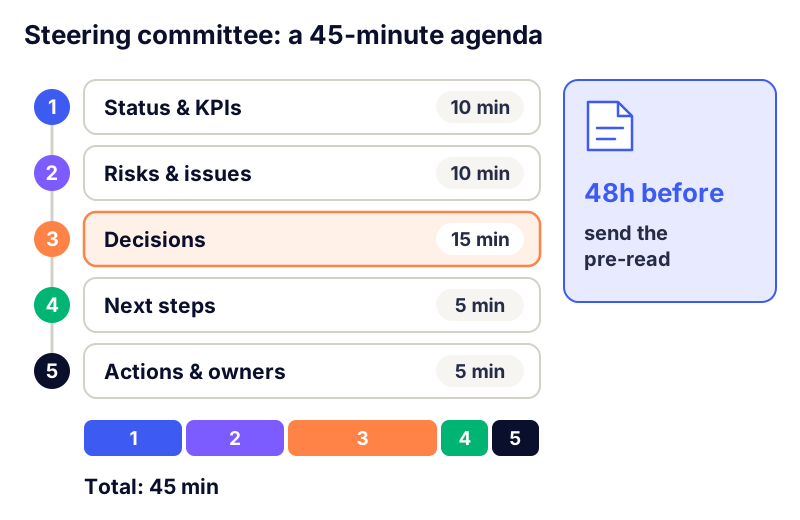
Agenda item | Time | Content | Expected output |
|---|---|---|---|
1. Status and KPIs | 10 min | RAG status, milestones, budget, highlights | Shared view of where things stand |
2. Risks and issues | 10 min | Top three risks, open issues, help needed | Mitigations approved, escalations named |
3. Decisions | 15 min | Options, impact, recommendation | Decisions made, with a decision-maker |
4. Next steps | 5 min | Upcoming milestones, watch points | Priorities for the next period |
5. Actions and owners | 5 min | Read back decisions and actions | Every action has an owner and a due date |
If the meeting runs long, cut status, never decisions. And if there's nothing to decide, replace the meeting with a written update instead of holding it for form's sake.
How to run a steering committee meeting that decides
Running a steering committee is mostly about protecting decision time. A few practices make the difference:
Frame each decision as a closed question. "Do you approve moving go-live to November 28 with no scope change?" beats "schedule update."
Bring options, not problems. Two or three options with their impact on schedule, cost and scope, then your recommendation.
Time-box every topic. Anything unresolved after ten minutes goes to a working group with an owner and a date to come back.
Let the chair decide. Without consensus, the sponsor makes the call; the project manager shouldn't leave without an answer.
Read decisions back at the end. Two minutes prevents conflicting interpretations the next morning.
Open your deck with a "Decisions needed today" slide. Members know from minute one what's expected of them, and the chair can reorder the agenda if time runs short.
The decision log template: your project's memory
A decision log is more useful than exhaustive minutes. For each decision, record:
a number and the meeting date;
the decision, in one sentence;
the context and the options that were rejected;
who made the decision;
the impact on schedule, budget or scope;
the resulting actions, each with an owner and a due date.
Send it within 24 hours and keep it in a single register the whole team can access. Six months later, when someone asks "why did we drop that workstream?", the answer will be there, with its context.
In RoadmapHero, decisions can be recorded directly on the relevant items in the plan, and each steering committee can have its own live view, shared through a link without anyone creating an account, so the deck doesn't have to be rebuilt before every meeting.
Common steering committee mistakes
A one-way status broadcast. An hour of progress slides and no decisions: the pre-read would have done the job.
Too many attendees. Past eight to ten people, nobody makes the call.
Members without authority. A delegate who can't commit their department pushes decisions to the next meeting.
Problems revealed in the room. Without a pre-read and pre-wiring, the meeting turns into a defensive debate.
Green until it's red. A comfortable RAG status defeats the purpose of the committee; written thresholds and disciplined project risk management keep it honest.
No decision log. A decision that isn't written down gets relitigated at the next meeting.
A useful steering committee is short, prepared and built around decisions. If you'd like your next one to be prepared from the live plan rather than a hand-built spreadsheet, you can create an account.
Frequently asked questions
What is the role of a steering committee in a project?
A project steering committee provides direction and makes the decisions the project team can't make alone. It approves the business case, budget and baseline plan, trades off schedule, cost and scope when needed, unblocks resources, oversees major risks and decides whether the project should continue, change course or stop. It doesn't manage day-to-day work, which stays with the project manager and the team.
Who should be on a project steering committee?
A steering committee usually includes the project sponsor as chair, the heads of the departments affected by the project, an IT or engineering lead, and a finance representative when the budget is significant. The project manager attends to prepare and present, and the PMO often acts as secretary. Five to eight members is a good size, and every member should have the authority to commit their department.
What should be on a steering committee meeting agenda?
A typical steering committee agenda has five items: status and KPIs, risks and issues, decisions, next steps, and a read-back of actions and owners. In a 45-minute meeting, that means about 10 minutes of status, 10 of risks, 15 of decisions and 10 to wrap up. Status is kept short because members have received a pre-read 48 hours earlier.
How often should a project steering committee meet?
For a project lasting six to eighteen months, meeting every four to six weeks is a good benchmark, ideally aligned with key milestones. Add a kickoff meeting, a closing meeting and, when needed, an ad hoc session if a critical issue requires a quick decision. Between meetings, a one-page status report keeps members informed without adding more meetings to their calendars.
What is the difference between a steering committee and a project board?
In practice they play the same role. Project board is the PRINCE2 term for the group that directs the project, typically combining an executive who owns the business case, senior users and senior suppliers. Steering committee is the more common term in many organizations and is often a little broader, bringing in finance or other departments. Both approve, trade off and decide; neither manages the day-to-day work.